• Home
  • Technology
  • Gaming
  • Entertainment
  • World & Business
  • Science
  • Sports
  • AI
HomeTechnologyGamingEntertainmentWorld & BusinessScienceSportsAI
AI
Reaction

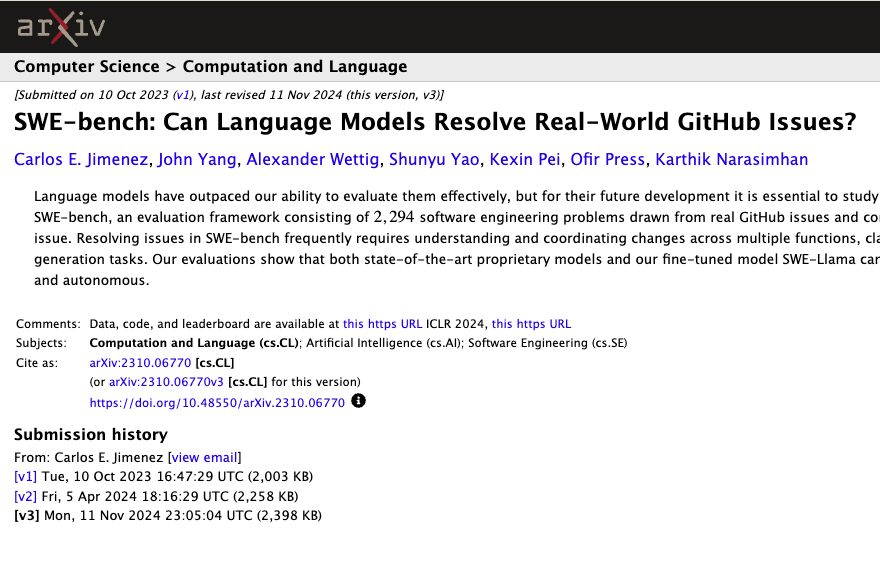
SWE-bench turns three amid a prediction that AI won’t replace software engineers within 10 years

The anniversary post predicts engineers will write less code, listen more to users and direct AI agents.

Ofir PressOP
1 Source, 45m ago, first seen 45m ago

TLDR

In an October 11, 2026, post marking SWE-bench’s third anniversary, the author predicts that even far more capable AI coding agents won’t replace human software engineers in the next 10 years. They expect engineers to read and write less code and spend more time listening to users and directing agents. They also predict a major AI coding breakthrough within 18 months, while suggesting the software engineer role could be phased out in 25 years as new jobs emerge.

Combined views

1.1K

1 Source, first seen 45m ago

28 likes12 comments2 reposts

Combined views

1.1K

1 Source, first seen 45m ago

28 likes12 comments2 reposts

Sentiment

Positive——Negative

Summary

Not enough discussion yet.

No sentiment analysis available yet.

Featured Source

Sentiment

Positive——Negative

Summary

Not enough discussion yet.

No sentiment analysis available yet.

1 Source

Ofir Press@OfirPressSWE-bench celebrates its 3rd anniversary today! Led by @closji & @jyangballin, it took AI coding from a niche subdomain to the center of the stage. Programmers don't write code by hand now, but the role of the human programmer is more challenging than ever and demand for human programmers is strong. Predictions for the next 3 years: 1. I don't think programmers are going anywhere, especially not in the next few years. Their role is going to substantially change, they're going to read and write less code, and they'll probably spend much more time listening to users. But they're still going to be here, directing a team of agents, analyzing user behavior, and translating vague emotions from leadership and users into concrete specifications. 2. We still have not reached the peak of AI coding, we have not even reached in AI coding the level of performance that AI math has achieved. We have not yet had the Navier-Stokes moment in AI coding. We'll know we've reached it when Linus Trovalds or Jeff Dean looks at some AI-generated code and says "Wow I couldn't have done this if you gave me 10 years, I didn't even think this was possible". I do expect this to be achieved in the next 18 months. 3. That being said, even when we do have these very capable AI agents that will reach this Navier-Stokes-level coding, those agents *will not* replace human SWEs (at least not in the next 10 years). That is kind of like expecting a drill to replace a contractor. Being a SWE is about much more than just coding. 4. Our job as people who want to push the AI frontier to build tools that are useful for humans, is to understand and formalize the gap between 'what agents can do' and 'what humans need'. And understanding where that gap is, is becoming harder than ever. But it's absolutely still there and we're going to be able to figure it out, in order to construct benchmarks and training data, that will lead to a narrowing of that gap. 5. What's happening in AI right now is really hard to grasp, the speed is hard to process, but this paradigm shift will not turn out to have been an unprecedented development. When we look back at this in 50 or 100 years, it will be comparable to other technological developments of the last 100 years including the mobile phone or the internet or the PC or the steam engine or electric grids. 6. Eventually, in 25 years, I could potentially see the role of SWE being phased out as a job, but by that point, there will be so many new jobs that existing SWEs could transition into. Some of these new growth roles might be: benchmark developer (to help their team understand which AI to use), AI agent manager (to manage very large teams of agents), AI red teamer (to try to break AI in simulated environments to make sure it doesn't break in production), and the existing role of product manager might become a much more substantial role in engineering orgs, and finally, there are many other jobs which will be invented that are hard to see right now.45m
    • Home
    • Technology
    • Gaming
    • Entertainment
    • World & Business
    • Science
    • Sports
    • AI

    1 Source

    Ofir Press@OfirPressSWE-bench celebrates its 3rd anniversary today! Led by @closji & @jyangballin, it took AI coding from a niche subdomain to the center of the stage. Programmers don't write code by hand now, but the role of the human programmer is more challenging than ever and demand for human programmers is strong. Predictions for the next 3 years: 1. I don't think programmers are going anywhere, especially not in the next few years. Their role is going to substantially change, they're going to read and write less code, and they'll probably spend much more time listening to users. But they're still going to be here, directing a team of agents, analyzing user behavior, and translating vague emotions from leadership and users into concrete specifications. 2. We still have not reached the peak of AI coding, we have not even reached in AI coding the level of performance that AI math has achieved. We have not yet had the Navier-Stokes moment in AI coding. We'll know we've reached it when Linus Trovalds or Jeff Dean looks at some AI-generated code and says "Wow I couldn't have done this if you gave me 10 years, I didn't even think this was possible". I do expect this to be achieved in the next 18 months. 3. That being said, even when we do have these very capable AI agents that will reach this Navier-Stokes-level coding, those agents *will not* replace human SWEs (at least not in the next 10 years). That is kind of like expecting a drill to replace a contractor. Being a SWE is about much more than just coding. 4. Our job as people who want to push the AI frontier to build tools that are useful for humans, is to understand and formalize the gap between 'what agents can do' and 'what humans need'. And understanding where that gap is, is becoming harder than ever. But it's absolutely still there and we're going to be able to figure it out, in order to construct benchmarks and training data, that will lead to a narrowing of that gap. 5. What's happening in AI right now is really hard to grasp, the speed is hard to process, but this paradigm shift will not turn out to have been an unprecedented development. When we look back at this in 50 or 100 years, it will be comparable to other technological developments of the last 100 years including the mobile phone or the internet or the PC or the steam engine or electric grids. 6. Eventually, in 25 years, I could potentially see the role of SWE being phased out as a job, but by that point, there will be so many new jobs that existing SWEs could transition into. Some of these new growth roles might be: benchmark developer (to help their team understand which AI to use), AI agent manager (to manage very large teams of agents), AI red teamer (to try to break AI in simulated environments to make sure it doesn't break in production), and the existing role of product manager might become a much more substantial role in engineering orgs, and finally, there are many other jobs which will be invented that are hard to see right now.45m
    Today's Rank

    —

    Not ranked yet

    Today's Rank

    —

    Not ranked yet