Vaibhav Srivastav, OpenAI developer experience lead, shares a workflow to turn recurring Codex patterns into reusable skills or subagents
Greg Brockman highlighted the method as a self-improvement prompt.
 #19Greg Brockman@GDB
self improvement prompt for codex
 Vaibhav (VB) Srivastav@reach_vb
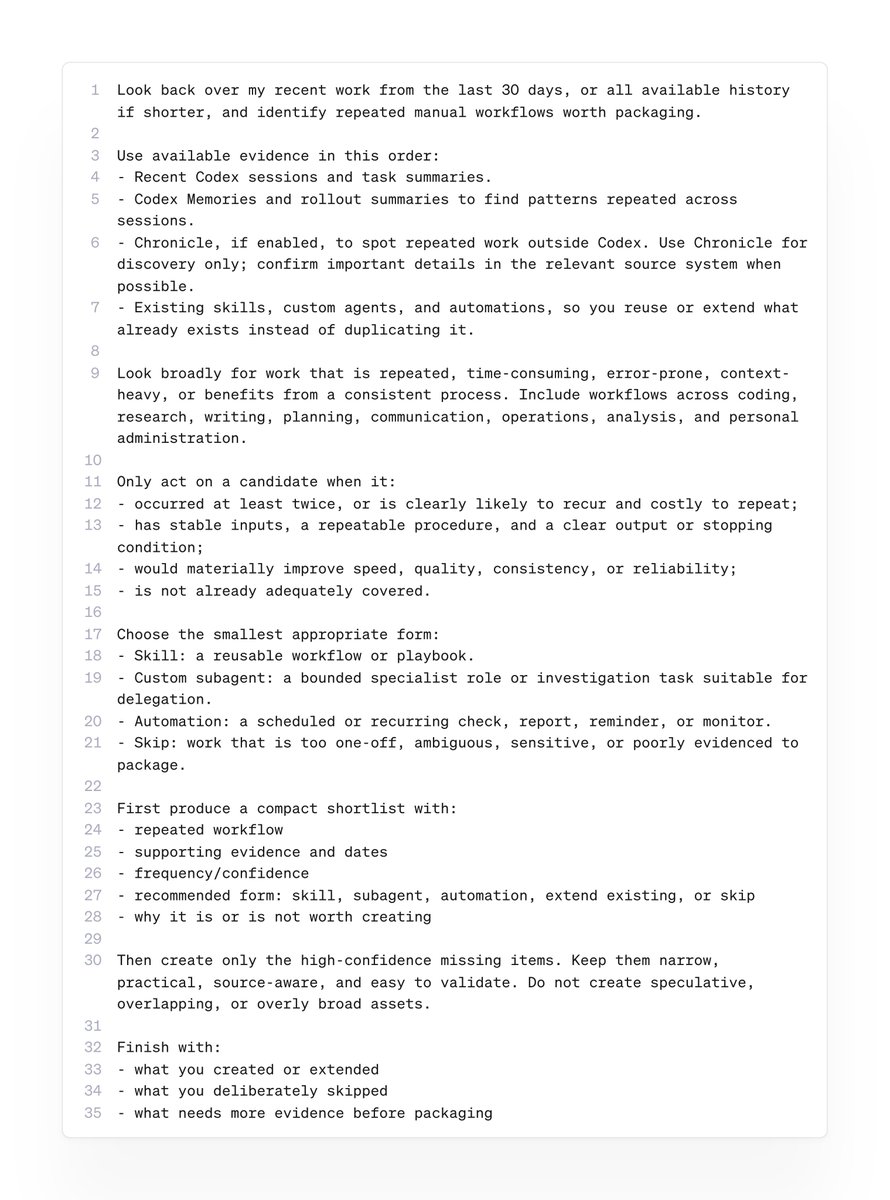
UPDATE: Came up with an even better version of this prompt after the feedback Ask Codex to look across your sessions, Memories, and Chronicle, identify patterns, reuse what already exists, and only create the smallest useful skill, subagent, or automation. "Look back over my recent work from the last 30 days, or all available history if shorter, and identify repeated manual workflows worth packaging. Use available evidence in this order: - Recent Codex sessions and task summaries. - Codex Memories and rollout summaries to find patterns repeated across sessions. - Chronicle, if enabled, to spot repeated work outside Codex. Use Chronicle for discovery only; confirm important details in the relevant source system when possible. - Existing skills, custom agents, and automations, so you reuse or extend what already exists instead of duplicating it. Look broadly for work that is repeated, time-consuming, error-prone, context-heavy, or benefits from a consistent process. Include workflows across coding, research, writing, planning, communication, operations, analysis, and personal administration. Only act on a candidate when it: - occurred at least twice, or is clearly likely to recur and costly to repeat; - has stable inputs, a repeatable procedure, and a clear output or stopping condition; - would materially improve speed, quality, consistency, or reliability; - is not already adequately covered. Choose the smallest appropriate form: - Skill: a reusable workflow or playbook. - Custom subagent: a bounded specialist role or investigation task suitable for delegation. - Automation: a scheduled or recurring check, report, reminder, or monitor. - Skip: work that is too one-off, ambiguous, sensitive, or poorly evidenced to package. First produce a compact shortlist with: - repeated workflow - supporting evidence and dates - frequency/confidence - recommended form: skill, subagent, automation, extend existing, or skip - why it is or is not worth creating Then create only the high-confidence missing items. Keep them narrow, practical, source-aware, and easy to validate. Do not create speculative, overlapping, or overly broad assets. Finish with: - what you created or extended - what you deliberately skipped - what needs more evidence before packaging"
#1853Vaibhav (VB) Srivastav@REACH_VBCame up with an even better version of this here:
Vaibhav (VB) Srivastav@reach_vbUPDATE: Came up with an even better version of this prompt after the feedback Ask Codex to look across your sessions, Memories, and Chronicle, identify patterns, reuse what already exists, and only create the smallest useful skill, subagent, or automation. "Look back over my recent work from the last 30 days, or all available history if shorter, and identify repeated manual workflows worth packaging. Use available evidence in this order: - Recent Codex sessions and task summaries. - Codex Memories and rollout summaries to find patterns repeated across sessions. - Chronicle, if enabled, to spot repeated work outside Codex. Use Chronicle for discovery only; confirm important details in the relevant source system when possible. - Existing skills, custom agents, and automations, so you reuse or extend what already exists instead of duplicating it. Look broadly for work that is repeated, time-consuming, error-prone, context-heavy, or benefits from a consistent process. Include workflows across coding, research, writing, planning, communication, operations, analysis, and personal administration. Only act on a candidate when it: - occurred at least twice, or is clearly likely to recur and costly to repeat; - has stable inputs, a repeatable procedure, and a clear output or stopping condition; - would materially improve speed, quality, consistency, or reliability; - is not already adequately covered. Choose the smallest appropriate form: - Skill: a reusable workflow or playbook. - Custom subagent: a bounded specialist role or investigation task suitable for delegation. - Automation: a scheduled or recurring check, report, reminder, or monitor. - Skip: work that is too one-off, ambiguous, sensitive, or poorly evidenced to package. First produce a compact shortlist with: - repeated workflow - supporting evidence and dates - frequency/confidence - recommended form: skill, subagent, automation, extend existing, or skip - why it is or is not worth creating Then create only the high-confidence missing items. Keep them narrow, practical, source-aware, and easy to validate. Do not create speculative, overlapping, or overly broad assets. Finish with: - what you created or extended - what you deliberately skipped - what needs more evidence before packaging"
#1853Vaibhav (VB) Srivastav@REACH_VBUPDATE: Came up with an even better version of this prompt after the feedback
Ask Codex to look across your sessions, Memories, and Chronicle, identify patterns, reuse what already exists, and only create the smallest useful skill, subagent, or automation.
"Look back over my recent work from the last 30 days, or all available history if shorter, and identify repeated manual workflows worth packaging.
Use available evidence in this order: - Recent Codex sessions and task summaries. - Codex Memories and rollout summaries to find patterns repeated across sessions. - Chronicle, if enabled, to spot repeated work outside Codex. Use Chronicle for discovery only; confirm important details in the relevant source system when possible. - Existing skills, custom agents, and automations, so you reuse or extend what already exists instead of duplicating it.
Look broadly for work that is repeated, time-consuming, error-prone, context-heavy, or benefits from a consistent process. Include workflows across coding, research, writing, planning, communication, operations, analysis, and personal administration.
Only act on a candidate when it: - occurred at least twice, or is clearly likely to recur and costly to repeat; - has stable inputs, a repeatable procedure, and a clear output or stopping condition; - would materially improve speed, quality, consistency, or reliability; - is not already adequately covered.
Choose the smallest appropriate form: - Skill: a reusable workflow or playbook. - Custom subagent: a bounded specialist role or investigation task suitable for delegation. - Automation: a scheduled or recurring check, report, reminder, or monitor. - Skip: work that is too one-off, ambiguous, sensitive, or poorly evidenced to package.
First produce a compact shortlist with: - repeated workflow - supporting evidence and dates - frequency/confidence - recommended form: skill, subagent, automation, extend existing, or skip - why it is or is not worth creating
Then create only the high-confidence missing items. Keep them narrow, practical, source-aware, and easy to validate. Do not create speculative, overlapping, or overly broad assets.
Finish with: - what you created or extended - what you deliberately skipped - what needs more evidence before packaging"
 Vaibhav (VB) Srivastav@reach_vb
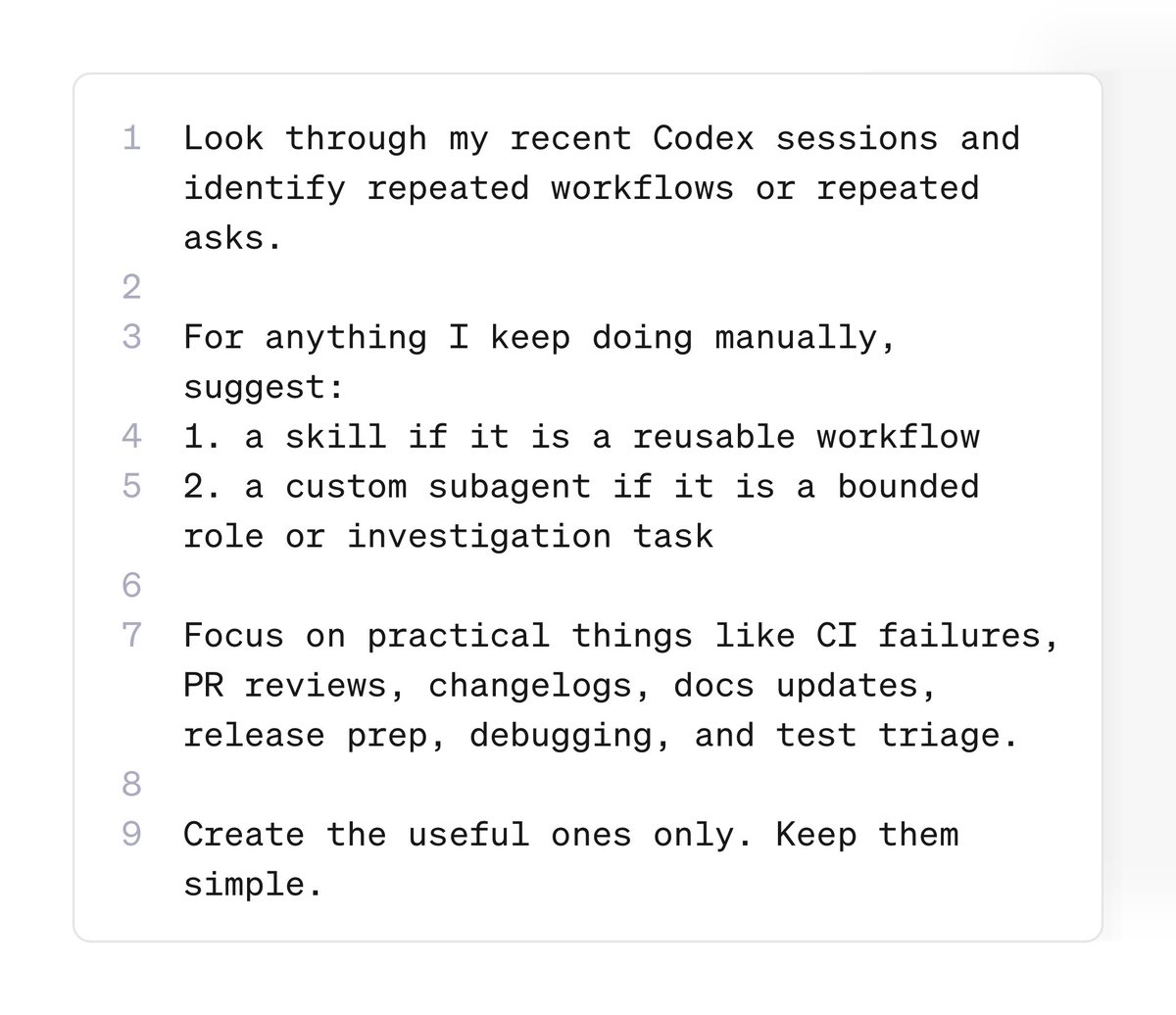
Copy and paste this into your codex: “Look through my recent Codex sessions and identify repeated workflows or repeated asks. For anything I keep doing manually, suggest: 1. a skill if it is a reusable workflow 2. a custom subagent if it is a bounded role or investigation task Focus on practical things like CI failures, PR reviews, changelogs, docs updates, release prep, debugging, and test triage. Create the useful ones only. Keep them simple.”
#1853Vaibhav (VB) Srivastav@REACH_VBCopy and paste this into your codex:
“Look through my recent Codex sessions and identify repeated workflows or repeated asks.
For anything I keep doing manually, suggest: 1. a skill if it is a reusable workflow 2. a custom subagent if it is a bounded role or investigation task
Focus on practical things like CI failures, PR reviews, changelogs, docs updates, release prep, debugging, and test triage.
Create the useful ones only. Keep them simple.”
 Vaibhav (VB) Srivastav@reach_vb
Codex Tip: ask Codex to look through your past sessions and turn repeated prompts into reusable skills + subagents you’ll probably find the same stuff showing up again and again: “check why CI failed” “review this PR” “write the changelog” “trace this bug” “clean up this diff” make it a skill if it’s a repeatable workflow or, make it a subagent if it’s a specific job you want to delegate