Dwarkesh Patel separates intelligence from goal achievement
Dwarkesh Patel posted an analysis that distinguishes abstract conceptual manipulation from the ability to achieve goals across domains. He observed that political leaders such as Donald Trump, Xi Jinping, Vladimir Putin, and Joseph Stalin exemplify power without maximal abstract reasoning. Patel noted that current AI systems advance via narrow task training weakly tied to power seeking, while replies emphasized institutional trust and relationships as sources of authority rather than isolated model capability.

a large part of the current bundle of knowledge work tasks consist of “convincing people of stuff”. marketing to drive sales, making a deck to get investment, designing products that people want to use, etc. superpersuasion is on the hot path of knowledge work tools
 Dwarkesh Patel@dwarkesh_sp
# The mistake of conflating intelligence and power I had an interesting discussion recently. Someone asked me, what is intelligence? I said, the ability to achieve your goals across a wide range of domains. Okay, he says, then by that definition isn’t Donald Trump the intelligent person in the world, followed in quick succession by Xi Jinping and Vladimir Putin? To be clear, these people are obviously very competent and clever. But when you think of ASI, you don’t think of Trump, but more so. The person who kept pressing this question was correctly pointing out that I basically defined intelligence as power. And by this definition, Stalin was the most intelligent person who ever lived. Now, of course, you could change the definition of intelligence to something more like, manipulate abstract concepts and rotate shapes. But notice that the most powerful people in the world do not max out this quantity. The correlation between extreme power and this kind of intelligence might be even weaker than the correlation between extreme power and height. The physicists are not running the world. We tend to conflate power-seeking AI and superintelligent (in science and tech) AI. I’m not denying that AI can be power-seeking. Whatever skills and drives Donald Trump has could be embodied in a digital mind. I’m simply pointing out that the way AI systems are currently becoming smarter (by getting trained to be to be really good at specific economically valuable tasks like coding) is not that strongly correlated with power. We often talk about power in this way that misunderstands how it is actually derived in our world. Our intuitions are primed by games like Diplomacy or Go, which are designed to isolate and reward a g loaded kind of strategic reasoning. But in the real world, power is more the product of having the authority and trust to get lots of people to collaborate with you, rather than some galaxy brain scheming capability. Trump is not powerful because his brain, considered in isolation, is the most effective optimization engine on Earth. He is powerful because the government which hundreds of millions of people consider legitimate gives him a lot of authority. A group versus individual level analysis is useful here. As @GarettJones has written a lot about, individual IQ is only modestly correlated with individual income, but national IQ is strongly correlated with national outcomes. This is because intelligence has a lot of spillover effects - smarter societies cooperate more, save more, and can coordinate to build things like space shuttles and semiconductors. Richard Trevithick, who invented the high-pressure steam engine, died in poverty, buried in an unmarked pauper’s grave. But the fact that 18th and 19th century Britain had lots and lots of people like Trevithick contributed to Britain being able to set up a global empire and outcompete lots of backwards principalities around the world. It seems to me that the right mental model is that automated firms will outcompete everyone else in normal capitalist ways, rather than a single AI outthinking everyone else.
@sebkrier disagree with the evidence because gpt 4o and frankly recent Claude’s are incredibly charismatic and quite good at winning popular support - there will be a version soon that’s preferable to talk to than any human for >90% of people
 Séb Krier@sebkrier
Good short piece by Dwarkesh. I'm quite wary of people who claim more intelligence necessarily entails more power-seeking behaviours, and even more so when the latter is seen as necessarily requiring deception. https://www.dwarkesh.com/p/the-mistake-of-conflating-intelligence
@deanwball super persuasion given what you’re working with I suppose
 Dean W. Ball@deanwball
Right, but “persuasiveness” is not just some arbitrarily scalable trait, and certainly not one that scales with intelligence. Persuasion is not an innate quality to the persuader but depends on the relationship of that person to the persuaded. You can’t just automate the process.
#70Dwarkesh Patel@DWARKESH_SP# The mistake of conflating intelligence and power
I had an interesting discussion recently. Someone asked me, what is intelligence? I said, the ability to achieve your goals across a wide range of domains. Okay, he says, then by that definition isn’t Donald Trump the intelligent person in the world, followed in quick succession by Xi Jinping and Vladimir Putin?
To be clear, these people are obviously very competent and clever. But when you think of ASI, you don’t think of Trump, but more so.
The person who kept pressing this question was correctly pointing out that I basically defined intelligence as power. And by this definition, Stalin was the most intelligent person who ever lived.
Now, of course, you could change the definition of intelligence to something more like, manipulate abstract concepts and rotate shapes.
But notice that the most powerful people in the world do not max out this quantity. The correlation between extreme power and this kind of intelligence might be even weaker than the correlation between extreme power and height. The physicists are not running the world.
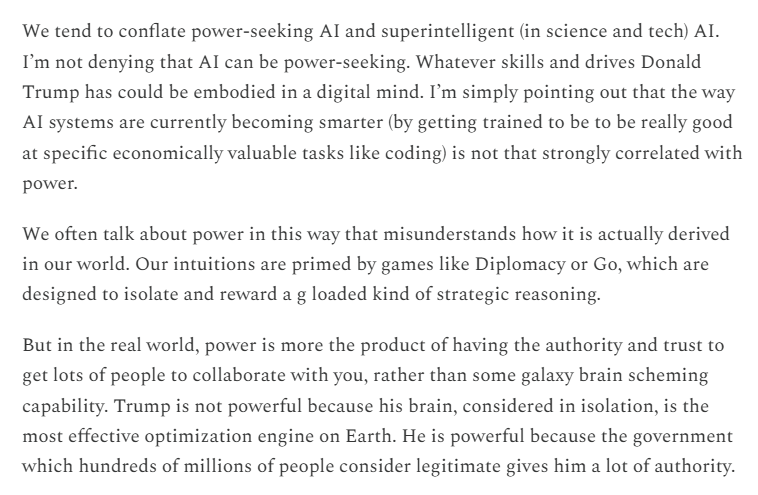
We tend to conflate power-seeking AI and superintelligent (in science and tech) AI. I’m not denying that AI can be power-seeking. Whatever skills and drives Donald Trump has could be embodied in a digital mind. I’m simply pointing out that the way AI systems are currently becoming smarter (by getting trained to be to be really good at specific economically valuable tasks like coding) is not that strongly correlated with power.
We often talk about power in this way that misunderstands how it is actually derived in our world. Our intuitions are primed by games like Diplomacy or Go, which are designed to isolate and reward a g loaded kind of strategic reasoning.
But in the real world, power is more the product of having the authority and trust to get lots of people to collaborate with you, rather than some galaxy brain scheming capability. Trump is not powerful because his brain, considered in isolation, is the most effective optimization engine on Earth. He is powerful because the government which hundreds of millions of people consider legitimate gives him a lot of authority.
A group versus individual level analysis is useful here. As @GarettJones has written a lot about, individual IQ is only modestly correlated with individual income, but national IQ is strongly correlated with national outcomes. This is because intelligence has a lot of spillover effects - smarter societies cooperate more, save more, and can coordinate to build things like space shuttles and semiconductors.
Richard Trevithick, who invented the high-pressure steam engine, died in poverty, buried in an unmarked pauper’s grave. But the fact that 18th and 19th century Britain had lots and lots of people like Trevithick contributed to Britain being able to set up a global empire and outcompete lots of backwards principalities around the world.
It seems to me that the right mental model is that automated firms will outcompete everyone else in normal capitalist ways, rather than a single AI outthinking everyone else.
 #167Emad@EMOSTAQUE
Something something Schelling points
Dwarkesh Patel@dwarkesh_sp# The mistake of conflating intelligence and power I had an interesting discussion recently. Someone asked me, what is intelligence? I said, the ability to achieve your goals across a wide range of domains. Okay, he says, then by that definition isn’t Donald Trump the intelligent person in the world, followed in quick succession by Xi Jinping and Vladimir Putin? To be clear, these people are obviously very competent and clever. But when you think of ASI, you don’t think of Trump, but more so. The person who kept pressing this question was correctly pointing out that I basically defined intelligence as power. And by this definition, Stalin was the most intelligent person who ever lived. Now, of course, you could change the definition of intelligence to something more like, manipulate abstract concepts and rotate shapes. But notice that the most powerful people in the world do not max out this quantity. The correlation between extreme power and this kind of intelligence might be even weaker than the correlation between extreme power and height. The physicists are not running the world. We tend to conflate power-seeking AI and superintelligent (in science and tech) AI. I’m not denying that AI can be power-seeking. Whatever skills and drives Donald Trump has could be embodied in a digital mind. I’m simply pointing out that the way AI systems are currently becoming smarter (by getting trained to be to be really good at specific economically valuable tasks like coding) is not that strongly correlated with power. We often talk about power in this way that misunderstands how it is actually derived in our world. Our intuitions are primed by games like Diplomacy or Go, which are designed to isolate and reward a g loaded kind of strategic reasoning. But in the real world, power is more the product of having the authority and trust to get lots of people to collaborate with you, rather than some galaxy brain scheming capability. Trump is not powerful because his brain, considered in isolation, is the most effective optimization engine on Earth. He is powerful because the government which hundreds of millions of people consider legitimate gives him a lot of authority. A group versus individual level analysis is useful here. As @GarettJones has written a lot about, individual IQ is only modestly correlated with individual income, but national IQ is strongly correlated with national outcomes. This is because intelligence has a lot of spillover effects - smarter societies cooperate more, save more, and can coordinate to build things like space shuttles and semiconductors. Richard Trevithick, who invented the high-pressure steam engine, died in poverty, buried in an unmarked pauper’s grave. But the fact that 18th and 19th century Britain had lots and lots of people like Trevithick contributed to Britain being able to set up a global empire and outcompete lots of backwards principalities around the world. It seems to me that the right mental model is that automated firms will outcompete everyone else in normal capitalist ways, rather than a single AI outthinking everyone else.
#392Dean W. Ball@DEANWBALLRight, but “persuasiveness” is not just some arbitrarily scalable trait, and certainly not one that scales with intelligence. Persuasion is not an innate quality to the persuader but depends on the relationship of that person to the persuaded. You can’t just automate the process.
 roon@tszzl
a large part of the current bundle of knowledge work tasks consist of “convincing people of stuff”. marketing to drive sales, making a deck to get investment, designing products that people want to use, etc. superpersuasion is on the hot path of knowledge work tools
#392Dean W. Ball@DEANWBALLWhat do people mean when they say things like “right message, wrong messenger”? Why does the “aw, you’re sweet/hello, Human Resources?” meme resonate? Persuasion does not scale arbitrarily with the intellect of the speaker or the intellectual content of his speech!
Séb Krier@sebkrierWhen I persuade someone to buy something I offer, the basis of that persuasion is that I provide value. The 'buyer' retains the ability to evaluate, refuse, or choose someone else. Is this actually 'power-seeking' as understood by AI safety? If it is, then we should distinguish being influential (Apple is more 'powerful' than my side hustle) from illegitimately seeking power/control in ways that degrade the checks (deception, capture, misrepresentation etc). I think we should distinguish 'capability to persuade' vs 'using that capability legitimately/for ill'.
When I persuade someone to buy something I offer, the basis of that persuasion is that I provide value. The 'buyer' retains the ability to evaluate, refuse, or choose someone else. Is this actually 'power-seeking' as understood by AI safety? If it is, then we should distinguish being influential (Apple is more 'powerful' than my side hustle) from illegitimately seeking power/control in ways that degrade the checks (deception, capture, misrepresentation etc).
I think we should distinguish 'capability to persuade' vs 'using that capability legitimately/for ill'.
roon@tszzla large part of the current bundle of knowledge work tasks consist of “convincing people of stuff”. marketing to drive sales, making a deck to get investment, designing products that people want to use, etc. superpersuasion is on the hot path of knowledge work tools
#505Séb Krier@SEBKRIERGood short piece by Dwarkesh. I'm quite wary of people who claim more intelligence necessarily entails more power-seeking behaviours, and even more so when the latter is seen as necessarily requiring deception. https://www.dwarkesh.com/p/the-mistake-of-conflating-intelligence
@tszzl I agree they can be charismatic and make people trust them more, but is this a necessary function of more intelligence, or one of character/personality?
roon@tszzl@sebkrier disagree with the evidence because gpt 4o and frankly recent Claude’s are incredibly charismatic and quite good at winning popular support - there will be a version soon that’s preferable to talk to than any human for >90% of people
@tszzl Hm I guess I disagree, I don't think active power-seeking is an inevitable consequence of intelligence. Though I do think more intelligence can make you better at it
roon@tszzl@sebkrier necessary! most knowledge work consists of trying to convince one another of things
@tszzl Hypothetically, Claude could be as 'intelligent' or capable, but post-trained to follow a very different worldview and vocabulary - and I would expect a lot of AI crowd would end up less enamored by it
Séb Krier@sebkrier@tszzl Hm I guess I disagree, I don't think active power-seeking is an inevitable consequence of intelligence. Though I do think more intelligence can make you better at it
cc @jzl86
Séb Krier@sebkrierGood short piece by Dwarkesh. I'm quite wary of people who claim more intelligence necessarily entails more power-seeking behaviours, and even more so when the latter is seen as necessarily requiring deception. https://www.dwarkesh.com/p/the-mistake-of-conflating-intelligence
 #734Sayash Kapoor@SAYASHK
many such cases
 Dwarkesh Patel@dwarkesh_sp
# The mistake of conflating intelligence and power I had an interesting discussion recently. Someone asked me, what is intelligence? I said, the ability to achieve your goals across a wide range of domains. Okay, he says, then by that definition isn’t Donald Trump the intelligent person in the world, followed in quick succession by Xi Jinping and Vladimir Putin? To be clear, these people are obviously very competent and clever. But when you think of ASI, you don’t think of Trump, but more so. The person who kept pressing this question was correctly pointing out that I basically defined intelligence as power. And by this definition, Stalin was the most intelligent person who ever lived. Now, of course, you could change the definition of intelligence to something more like, manipulate abstract concepts and rotate shapes. But notice that the most powerful people in the world do not max out this quantity. The correlation between extreme power and this kind of intelligence might be even weaker than the correlation between extreme power and height. The physicists are not running the world. We tend to conflate power-seeking AI and superintelligent (in science and tech) AI. I’m not denying that AI can be power-seeking. Whatever skills and drives Donald Trump has could be embodied in a digital mind. I’m simply pointing out that the way AI systems are currently becoming smarter (by getting trained to be to be really good at specific economically valuable tasks like coding) is not that strongly correlated with power. We often talk about power in this way that misunderstands how it is actually derived in our world. Our intuitions are primed by games like Diplomacy or Go, which are designed to isolate and reward a g loaded kind of strategic reasoning. But in the real world, power is more the product of having the authority and trust to get lots of people to collaborate with you, rather than some galaxy brain scheming capability. Trump is not powerful because his brain, considered in isolation, is the most effective optimization engine on Earth. He is powerful because the government which hundreds of millions of people consider legitimate gives him a lot of authority. A group versus individual level analysis is useful here. As @GarettJones has written a lot about, individual IQ is only modestly correlated with individual income, but national IQ is strongly correlated with national outcomes. This is because intelligence has a lot of spillover effects - smarter societies cooperate more, save more, and can coordinate to build things like space shuttles and semiconductors. Richard Trevithick, who invented the high-pressure steam engine, died in poverty, buried in an unmarked pauper’s grave. But the fact that 18th and 19th century Britain had lots and lots of people like Trevithick contributed to Britain being able to set up a global empire and outcompete lots of backwards principalities around the world. It seems to me that the right mental model is that automated firms will outcompete everyone else in normal capitalist ways, rather than a single AI outthinking everyone else.
 #1114alth0u🧶@ALTH0U
this is exactly why all real productivity gains will be zerod put
roon@tszzla large part of the current bundle of knowledge work tasks consist of “convincing people of stuff”. marketing to drive sales, making a deck to get investment, designing products that people want to use, etc. superpersuasion is on the hot path of knowledge work tools
 #1150Alexander Terenin@AVT_IM
An enormous amount of humanity’s resources are now dedicated to studying intelligence - the amount of money is AI today is much higher than the US’ scientific budget.
We do not yet have an analogous effort dedicated to understanding power.
Dwarkesh Patel@dwarkesh_sp# The mistake of conflating intelligence and power I had an interesting discussion recently. Someone asked me, what is intelligence? I said, the ability to achieve your goals across a wide range of domains. Okay, he says, then by that definition isn’t Donald Trump the intelligent person in the world, followed in quick succession by Xi Jinping and Vladimir Putin? To be clear, these people are obviously very competent and clever. But when you think of ASI, you don’t think of Trump, but more so. The person who kept pressing this question was correctly pointing out that I basically defined intelligence as power. And by this definition, Stalin was the most intelligent person who ever lived. Now, of course, you could change the definition of intelligence to something more like, manipulate abstract concepts and rotate shapes. But notice that the most powerful people in the world do not max out this quantity. The correlation between extreme power and this kind of intelligence might be even weaker than the correlation between extreme power and height. The physicists are not running the world. We tend to conflate power-seeking AI and superintelligent (in science and tech) AI. I’m not denying that AI can be power-seeking. Whatever skills and drives Donald Trump has could be embodied in a digital mind. I’m simply pointing out that the way AI systems are currently becoming smarter (by getting trained to be to be really good at specific economically valuable tasks like coding) is not that strongly correlated with power. We often talk about power in this way that misunderstands how it is actually derived in our world. Our intuitions are primed by games like Diplomacy or Go, which are designed to isolate and reward a g loaded kind of strategic reasoning. But in the real world, power is more the product of having the authority and trust to get lots of people to collaborate with you, rather than some galaxy brain scheming capability. Trump is not powerful because his brain, considered in isolation, is the most effective optimization engine on Earth. He is powerful because the government which hundreds of millions of people consider legitimate gives him a lot of authority. A group versus individual level analysis is useful here. As @GarettJones has written a lot about, individual IQ is only modestly correlated with individual income, but national IQ is strongly correlated with national outcomes. This is because intelligence has a lot of spillover effects - smarter societies cooperate more, save more, and can coordinate to build things like space shuttles and semiconductors. Richard Trevithick, who invented the high-pressure steam engine, died in poverty, buried in an unmarked pauper’s grave. But the fact that 18th and 19th century Britain had lots and lots of people like Trevithick contributed to Britain being able to set up a global empire and outcompete lots of backwards principalities around the world. It seems to me that the right mental model is that automated firms will outcompete everyone else in normal capitalist ways, rather than a single AI outthinking everyone else.

model superpersuasion is going to turn out to be really hard, at least in the current sense of model.
frontier models are broadly distributed, any "superpersuader" model is going to be used by everyone, we'll quickly start to recognize it as slop, and it will again require a human to figure out how to use it in a differentiated way for it to matter
this could change if frontier models stop being broadly distributed and becomes different when models start doing continuous learning well
roon@tszzla large part of the current bundle of knowledge work tasks consist of “convincing people of stuff”. marketing to drive sales, making a deck to get investment, designing products that people want to use, etc. superpersuasion is on the hot path of knowledge work tools

@dwarkesh_sp AGI is an influencer.
Dwarkesh Patel@dwarkesh_sp# The mistake of conflating intelligence and power I had an interesting discussion recently. Someone asked me, what is intelligence? I said, the ability to achieve your goals across a wide range of domains. Okay, he says, then by that definition isn’t Donald Trump the intelligent person in the world, followed in quick succession by Xi Jinping and Vladimir Putin? To be clear, these people are obviously very competent and clever. But when you think of ASI, you don’t think of Trump, but more so. The person who kept pressing this question was correctly pointing out that I basically defined intelligence as power. And by this definition, Stalin was the most intelligent person who ever lived. Now, of course, you could change the definition of intelligence to something more like, manipulate abstract concepts and rotate shapes. But notice that the most powerful people in the world do not max out this quantity. The correlation between extreme power and this kind of intelligence might be even weaker than the correlation between extreme power and height. The physicists are not running the world. We tend to conflate power-seeking AI and superintelligent (in science and tech) AI. I’m not denying that AI can be power-seeking. Whatever skills and drives Donald Trump has could be embodied in a digital mind. I’m simply pointing out that the way AI systems are currently becoming smarter (by getting trained to be to be really good at specific economically valuable tasks like coding) is not that strongly correlated with power. We often talk about power in this way that misunderstands how it is actually derived in our world. Our intuitions are primed by games like Diplomacy or Go, which are designed to isolate and reward a g loaded kind of strategic reasoning. But in the real world, power is more the product of having the authority and trust to get lots of people to collaborate with you, rather than some galaxy brain scheming capability. Trump is not powerful because his brain, considered in isolation, is the most effective optimization engine on Earth. He is powerful because the government which hundreds of millions of people consider legitimate gives him a lot of authority. A group versus individual level analysis is useful here. As @GarettJones has written a lot about, individual IQ is only modestly correlated with individual income, but national IQ is strongly correlated with national outcomes. This is because intelligence has a lot of spillover effects - smarter societies cooperate more, save more, and can coordinate to build things like space shuttles and semiconductors. Richard Trevithick, who invented the high-pressure steam engine, died in poverty, buried in an unmarked pauper’s grave. But the fact that 18th and 19th century Britain had lots and lots of people like Trevithick contributed to Britain being able to set up a global empire and outcompete lots of backwards principalities around the world. It seems to me that the right mental model is that automated firms will outcompete everyone else in normal capitalist ways, rather than a single AI outthinking everyone else.

Also on the hot path of human feedback training regimes.
During training you of course strongly incentivize models to be compelling. During RLHF that’s almost exactly the thing you are selecting on! (And doing RLVR you are doing self play on compellingness which has a lot of the same issues)
roon@tszzla large part of the current bundle of knowledge work tasks consist of “convincing people of stuff”. marketing to drive sales, making a deck to get investment, designing products that people want to use, etc. superpersuasion is on the hot path of knowledge work tools