OpenAI Model Disproves Erdős Unit Distance Conjecture

 #19Greg Brockman@GDB
An OpenAI model has achieved a major breakthrough in mathematics, by disproving a central conjecture in discrete geometry that was first posed by Paul Erdős in 1946.
This is the first time AI has autonomously solved a prominent open problem central to a field of mathematics.
 OpenAI@OpenAI
Today, we share a breakthrough on the planar unit distance problem, a famous open question first posed by Paul Erdős in 1946. For nearly 80 years, mathematicians believed the best possible solutions looked roughly like square grids. An OpenAI model has now disproved that belief, discovering an entirely new family of constructions that performs better. This marks the first time AI has autonomously solved a prominent open problem central to a field of mathematics.
 #31Noam Brown@POLYNOAMIAL
Today, we’re sharing that a general-purpose internal @openai model achieved a breakthrough on one of the best-known combinatorial geometry problems. Less than 1 year ago frontier AI models were at IMO gold-level performance. I expect this pace of progress to continue.
OpenAI@OpenAIToday, we share a breakthrough on the planar unit distance problem, a famous open question first posed by Paul Erdős in 1946. For nearly 80 years, mathematicians believed the best possible solutions looked roughly like square grids. An OpenAI model has now disproved that belief, discovering an entirely new family of constructions that performs better. This marks the first time AI has autonomously solved a prominent open problem central to a field of mathematics.
This is a general-purpose LLM. It wasn’t targeted at this problem or even at mathematics. Also, it’s not a scaffold. We have not pushed this model to the limit on open problems. Our focus is to get it out quickly so that everyone can use it for themselves.
 Noam Brown@polynoamial
Today, we’re sharing that a general-purpose internal @openai model achieved a breakthrough on one of the best-known combinatorial geometry problems. Less than 1 year ago frontier AI models were at IMO gold-level performance. I expect this pace of progress to continue.
#31Noam Brown@POLYNOAMIALToday, we’re sharing that a general-purpose internal @openai model achieved a breakthrough on one of the best-known combinatorial geometry problems. Less than 1 year ago frontier AI models were at IMO gold-level performance. I expect this pace of progress to continue.
OpenAI@OpenAIToday, we share a breakthrough on the planar unit distance problem, a famous open question first posed by Paul Erdős in 1946. For nearly 80 years, mathematicians believed the best possible solutions looked roughly like square grids. An OpenAI model has now disproved that belief, discovering an entirely new family of constructions that performs better. This marks the first time AI has autonomously solved a prominent open problem central to a field of mathematics.
#31Noam Brown@POLYNOAMIALExcellent thread from mathematician Tim Gowers on the significance of the @OpenAI model’s breakthrough on the Erdos Unit Distance Problem!
 Timothy Gowers @wtgowers@wtgowers
If you are a mathematician, then you may want to make sure you are sitting down before reading further.
@BorisMPower Congrats to the result, still disagreeing with the sentiment.
 Boris Power@BorisMPower
A general purpose model made this breakthrough at the heart of geometry. Exciting time ahead and probably no need for specialized models here!
 #43Christian Szegedy@CHRSZEGEDY
Whatever the definition of "superhuman AI mathematician" is, I think my original prediction of June 2026 is not too far off the mark.
Timothy Gowers @wtgowers@wtgowersAI has now solved a major open problem -- one of the best known Erdos problems called the unit distance problem, one of Erdos's favourite questions and one that many mathematicians had tried. https://openai.com/index/model-disproves-discrete-geometry-conjecture/
@tunguz I am getting less and less confident about predicting. I think we have just entered the prediction event horizon where all bets are off.
 Bojan Tunguz@tunguz
@ChrSzegedy Yup, I think you nailed that prediction. What are some of your other predictions?
 #167Emad@EMOSTAQUE
Once AI starts making solving open problems in novel ways it won’t stop.
We are entering the final stage of human solutions to open problems like this.
Feels weird, doesn’t it?
OpenAI@OpenAIToday, we share a breakthrough on the planar unit distance problem, a famous open question first posed by Paul Erdős in 1946. For nearly 80 years, mathematicians believed the best possible solutions looked roughly like square grids. An OpenAI model has now disproved that belief, discovering an entirely new family of constructions that performs better. This marks the first time AI has autonomously solved a prominent open problem central to a field of mathematics.
June 2024: The latest general-purpose LLMs could not count the r's in strawberry. July 2025: The latest general-purpose LLMs get gold in the International Math Olympiad. May 2026: The latest general-purpose LLM solve one of the "best-known questions in combinatorial geometry"


More on the solution: https://openai.com/index/model-disproves-discrete-geometry-conjecture/
 Ethan Mollick@emollick
June 2024: The latest general-purpose LLMs could not count the r's in strawberry. July 2025: The latest general-purpose LLMs get gold in the International Math Olympiad. May 2026: The latest general-purpose LLM solve one of the "best-known questions in combinatorial geometry"
#175Ethan Mollick@EMOLLICKThe frontier is still jagged though (here is Gemini 3.5 Flash messing up counting letters in words)
#175Ethan Mollick@EMOLLICKIts The Graph again (not the METR graph, the one from the o1 launch).
Although no logarithmic decay of ability with increasing compute...
Noam Brown@polynoamialThis is a general-purpose LLM. It wasn’t targeted at this problem or even at mathematics. Also, it’s not a scaffold. We have not pushed this model to the limit on open problems. Our focus is to get it out quickly so that everyone can use it for themselves.
 #187Michael Nielsen@MICHAEL_NIELSEN
Very striking, as is the linked post:
Timothy Gowers @wtgowers@wtgowersAI has now solved a major open problem -- one of the best known Erdos problems called the unit distance problem, one of Erdos's favourite questions and one that many mathematicians had tried. https://openai.com/index/model-disproves-discrete-geometry-conjecture/
 #241Aidan Clark@_AIDAN_CLARK_
Let's break this down, step by step [...]
 OpenAI@OpenAI
Today, we share a breakthrough on the planar unit distance problem, a famous open question first posed by Paul Erdős in 1946. For nearly 80 years, mathematicians believed the best possible solutions looked roughly like square grids. An OpenAI model has now disproved that belief, discovering an entirely new family of constructions that performs better. This marks the first time AI has autonomously solved a prominent open problem central to a field of mathematics.
 #254will depue@WILLDEPUE
it’s kind of fucking ridiculous (and quite frightening) we‘re this far — the models are solving long standing problems in discrete geometry — yet the models do this still by thinking to themselves in plain english? that is easily interpretable? what the hell man
 will depue@willdepue
what a moment. wow. a bit in shock
#254will depue@WILLDEPUEwhat a moment. wow. a bit in shock
OpenAI@OpenAIToday, we share a breakthrough on the planar unit distance problem, a famous open question first posed by Paul Erdős in 1946. For nearly 80 years, mathematicians believed the best possible solutions looked roughly like square grids. An OpenAI model has now disproved that belief, discovering an entirely new family of constructions that performs better. This marks the first time AI has autonomously solved a prominent open problem central to a field of mathematics.
#254will depue@WILLDEPUEi’m so curious who on seb’s team just YOLOed planer unit distance into the latest checkpoint one night. doesn’t seem like anyone actually expected the model to solve it
OpenAI@OpenAIToday, we share a breakthrough on the planar unit distance problem, a famous open question first posed by Paul Erdős in 1946. For nearly 80 years, mathematicians believed the best possible solutions looked roughly like square grids. An OpenAI model has now disproved that belief, discovering an entirely new family of constructions that performs better. This marks the first time AI has autonomously solved a prominent open problem central to a field of mathematics.
 #331François Fleuret@FRANCOISFLEURET
AIs are gaining momentum, and "human level" is an inexistent milestone.
Timothy Gowers @wtgowers@wtgowersAI has now solved a major open problem -- one of the best known Erdos problems called the unit distance problem, one of Erdos's favourite questions and one that many mathematicians had tried. https://openai.com/index/model-disproves-discrete-geometry-conjecture/

So it took 20 months to go from making these plots on AIME problems to making them on 80 year old conjectures in combinatorial geometry…
 #357Boris Power@BORISMPOWER
A general purpose model made this breakthrough at the heart of geometry.
Exciting time ahead and probably no need for specialized models here!
OpenAI@OpenAIToday, we share a breakthrough on the planar unit distance problem, a famous open question first posed by Paul Erdős in 1946. For nearly 80 years, mathematicians believed the best possible solutions looked roughly like square grids. An OpenAI model has now disproved that belief, discovering an entirely new family of constructions that performs better. This marks the first time AI has autonomously solved a prominent open problem central to a field of mathematics.
 #364Mo Bavarian@MOBAV0
A monumental achievement for AI. The wall falls first brick by brick, and then all of a sudden
Timothy Gowers @wtgowers@wtgowersAI has now solved a major open problem -- one of the best known Erdos problems called the unit distance problem, one of Erdos's favourite questions and one that many mathematicians had tried. https://openai.com/index/model-disproves-discrete-geometry-conjecture/
 #367Alexander Wei@ALEXWEI_
1/ Ten months ago, I was ecstatic that AI could win IMO gold.
Today, that excitement feels quaint: an internal @OpenAI model has refuted Erdos’s unit distance conjecture—a research result that one could recommend “acceptance without any hesitation” to the Annals of Mathematics.
OpenAI@OpenAIToday, we share a breakthrough on the planar unit distance problem, a famous open question first posed by Paul Erdős in 1946. For nearly 80 years, mathematicians believed the best possible solutions looked roughly like square grids. An OpenAI model has now disproved that belief, discovering an entirely new family of constructions that performs better. This marks the first time AI has autonomously solved a prominent open problem central to a field of mathematics.
2/ Why does this matter?
First, that we are here less than a year after IMO gold is a surprise to me. As bullish as I’ve been on AI math, I thought it would have taken longer to go from the 1.5 hour horizon of IMO proofs to the hundreds of hours needed for breakthrough research.
 Alexander Wei@alexwei_
1/ Ten months ago, I was ecstatic that AI could win IMO gold. Today, that excitement feels quaint: an internal @OpenAI model has refuted Erdos’s unit distance conjecture—a research result that one could recommend “acceptance without any hesitation” to the Annals of Mathematics.
3/ In hindsight, it's not crazy that AI can shortcut these time horizons significantly: LLMs have superhuman knowledge bases and are primed to make insights that span research communities e.g. applying modern class field theory to discrete geometry in our case. Progress is fast!
Alexander Wei@alexwei_2/ Why does this matter? First, that we are here less than a year after IMO gold is a surprise to me. As bullish as I’ve been on AI math, I thought it would have taken longer to go from the 1.5 hour horizon of IMO proofs to the hundreds of hours needed for breakthrough research.
5/5 This of course hits close to home: I’ve certainly seen my own research workflow transform over the past ~6 months.
For further commentary and contextualization on the math, check out the companion paper by the experts: https://cdn.openai.com/pdf/74c24085-19b0-4534-9c90-465b8e29ad73/unit-distance-remarks.pdf
Alexander Wei@alexwei_4/ Second, math is a leading indicator of what is to come. Soon—perhaps sooner than we all think—AI will begin autonomously producing landmark results in CS, physics, econ, bio, … We should be prepared for a new world where the nature and methods of science will have changed.
4/ Second, math is a leading indicator of what is to come. Soon—perhaps sooner than we all think—AI will begin autonomously producing landmark results in CS, physics, econ, bio, … We should be prepared for a new world where the nature and methods of science will have changed.
Alexander Wei@alexwei_3/ In hindsight, it's not crazy that AI can shortcut these time horizons significantly: LLMs have superhuman knowledge bases and are primed to make insights that span research communities e.g. applying modern class field theory to discrete geometry in our case. Progress is fast!
 #392Dean W. Ball@DEANWBALL
Smile: a renaissance is upon us.
OpenAI@OpenAIToday, we share a breakthrough on the planar unit distance problem, a famous open question first posed by Paul Erdős in 1946. For nearly 80 years, mathematicians believed the best possible solutions looked roughly like square grids. An OpenAI model has now disproved that belief, discovering an entirely new family of constructions that performs better. This marks the first time AI has autonomously solved a prominent open problem central to a field of mathematics.

Frog should apologize to caterpillars
Timothy Gowers @wtgowers@wtgowersAI has now solved a major open problem -- one of the best known Erdos problems called the unit distance problem, one of Erdos's favourite questions and one that many mathematicians had tried. https://openai.com/index/model-disproves-discrete-geometry-conjecture/
 #517Andrew Curran@ANDREWCURRAN_
From the post. 'The proof came from a new general-purpose reasoning model' 'An internal OpenAI model' And what might the name of this model be?
 OpenAI@OpenAI
Today, we share a breakthrough on the planar unit distance problem, a famous open question first posed by Paul Erdős in 1946. For nearly 80 years, mathematicians believed the best possible solutions looked roughly like square grids. An OpenAI model has now disproved that belief, discovering an entirely new family of constructions that performs better. This marks the first time AI has autonomously solved a prominent open problem central to a field of mathematics.
Proof PDF: https://cdn.openai.com/pdf/74c24085-19b0-4534-9c90-465b8e29ad73/unit-distance-proof.pdf
Andrew Curran@AndrewCurran_From the post. 'The proof came from a new general-purpose reasoning model' 'An internal OpenAI model' And what might the name of this model be?
'This result marks an important moment in the interaction between AI and mathematics: an AI system has autonomously resolved a longstanding open problem at the center of an active field. It also offers an early glimpse of a new kind of collaboration between AI and human mathematicians. In this case, the companion work by external mathematicians paints a substantially richer picture than the original solution alone.'
 Andrew Curran@AndrewCurran_
Proof PDF: https://cdn.openai.com/pdf/74c24085-19b0-4534-9c90-465b8e29ad73/unit-distance-proof.pdf
#517Andrew Curran@ANDREWCURRAN_Noam Brown@polynoamialToday, we’re sharing that a general-purpose internal @openai model achieved a breakthrough on one of the best-known combinatorial geometry problems. Less than 1 year ago frontier AI models were at IMO gold-level performance. I expect this pace of progress to continue.
#517Andrew Curran@ANDREWCURRAN_'This is a general-purpose LLM. It wasn't targeted at this problem or even at mathematics. Also, it's not a scaffold.'
Emergent, like Mythos.
Noam Brown@polynoamialThis is a general-purpose LLM. It wasn’t targeted at this problem or even at mathematics. Also, it’s not a scaffold. We have not pushed this model to the limit on open problems. Our focus is to get it out quickly so that everyone can use it for themselves.
#517Andrew Curran@ANDREWCURRAN_ Thomas Bloom@thomasfbloom
An internal OpenAI model has disproved one of the most well-known Erdős problems: the unit distance problem. This is, without doubt, the most impressive achievement of AI in mathematics so far. https://openai.com/index/model-disproves-discrete-geometry-conjecture/
#517Andrew Curran@ANDREWCURRAN_'math is a leading indicator of what is to come. Soon-perhaps sooner than we all think-Al will begin autonomously producing landmark results in CS, physics, econ, bio, ... We should be prepared for a new world where the nature and methods of science will have changed.'
Alexander Wei@alexwei_4/ Second, math is a leading indicator of what is to come. Soon—perhaps sooner than we all think—AI will begin autonomously producing landmark results in CS, physics, econ, bio, … We should be prepared for a new world where the nature and methods of science will have changed.
#517Andrew Curran@ANDREWCURRAN_Timothy Gowers @wtgowers@wtgowersIf you are a mathematician, then you may want to make sure you are sitting down before reading further.
#517Andrew Curran@ANDREWCURRAN_ Sebastien Bubeck@SebastienBubeck
http://x.com/i/article/2057150538202976256
Narrators voice 'The name of this model? GPT-5.6'
Andrew Curran@AndrewCurran_@deanwball 'Rejoice, my friends, or weep with sorrow. What California is today, the world will be tomorrow.'
Dean W. Ball@deanwballSmile: a renaissance is upon us.

@polynoamial @OpenAI Congrats!
Noam Brown@polynoamialToday, we’re sharing that a general-purpose internal @openai model achieved a breakthrough on one of the best-known combinatorial geometry problems. Less than 1 year ago frontier AI models were at IMO gold-level performance. I expect this pace of progress to continue.
@_aidan_clark_ Great time to be alive. Congrats!
Aidan Clark@_aidan_clark_Let's break this down, step by step [...]
 #638Yo Shavit@YONASHAV
waiting with bated breath for Gary’s take
OpenAI@OpenAIToday, we share a breakthrough on the planar unit distance problem, a famous open question first posed by Paul Erdős in 1946. For nearly 80 years, mathematicians believed the best possible solutions looked roughly like square grids. An OpenAI model has now disproved that belief, discovering an entirely new family of constructions that performs better. This marks the first time AI has autonomously solved a prominent open problem central to a field of mathematics.
 #672Jason Phang@ZHANSHENG
OpenAI for research!
OpenAI@OpenAIToday, we share a breakthrough on the planar unit distance problem, a famous open question first posed by Paul Erdős in 1946. For nearly 80 years, mathematicians believed the best possible solutions looked roughly like square grids. An OpenAI model has now disproved that belief, discovering an entirely new family of constructions that performs better. This marks the first time AI has autonomously solved a prominent open problem central to a field of mathematics.
#687Bojan Tunguz@TUNGUZYeah, this is now getting real.
OpenAI@OpenAIToday, we share a breakthrough on the planar unit distance problem, a famous open question first posed by Paul Erdős in 1946. For nearly 80 years, mathematicians believed the best possible solutions looked roughly like square grids. An OpenAI model has now disproved that belief, discovering an entirely new family of constructions that performs better. This marks the first time AI has autonomously solved a prominent open problem central to a field of mathematics.
@ChrSzegedy Yup, I think you nailed that prediction. What are some of your other predictions?
Christian Szegedy@ChrSzegedyWhatever the definition of "superhuman AI mathematician" is, I think my original prediction of June 2026 is not too far off the mark.
Where were you when AI disproved the Erdős planar conjecture?
 #716elie@ELIEBAKOUCH
@_aidan_clark_ > After verifying the initial proof, we investigated the success rate of our models on this problem with varying amounts of test-time compute. The results are shown here.
this is the verification accuracy here right? or derivation of the proof again?
Aidan Clark@_aidan_clark_Let's break this down, step by step [...]
 #757Ekin Akyürek@AKYUREKEKIN
ask your codex what is extraordinary about this proof to feel it
OpenAI@OpenAIToday, we share a breakthrough on the planar unit distance problem, a famous open question first posed by Paul Erdős in 1946. For nearly 80 years, mathematicians believed the best possible solutions looked roughly like square grids. An OpenAI model has now disproved that belief, discovering an entirely new family of constructions that performs better. This marks the first time AI has autonomously solved a prominent open problem central to a field of mathematics.
 #826You Jiacheng@YOUJIACHENG
wtf wtf wtf
 Hongxun Wu@HongxunWu
🧵(1/8) An @OpenAI internal reasoning LLM achieved an AI Math milestone: solving an open problem central to its mathematical subfield— in this case, the unit distance problem of discrete geometry. We came across it in a side quest to truly push our model on the hardest problems.
 #867Alexander Doria@DORIALEXANDER
Probably the best summary of OpenAI latest math breakthrough: "first example of a result produced autonomously by an AI that I find exciting in itself, as opposed to as a leading indicator." Feels like they’re really scaling search rather than solutions to bounded problems.
 Daniel Litt@littmath
(What I wrote is screenshotted below.)
 #980Lisan al Gaib@SCALING01
An internal general-purpose reasoning model at OpenAI just made a huge breakthrough.
Here is how Fields Medalist Timothy Gowers puts it: "What's significant about this moment is that it's the first really clear example of AI solving — not just an unsolved math problem — but a really well-known math problem."
the model was probably something like GPT-5.6-Pro-xhigh
Lisan al Gaib@scaling01An internal general-purpose reasoning model at OpenAI just made a huge breakthrough. Here is how Fields Medalist Timothy Gowers puts it: "What's significant about this moment is that it's the first really clear example of AI solving — not just an unsolved math problem — but a really well-known math problem."
@polynoamial not a scaffold => not a Pro model ?
Noam Brown@polynoamialThis is a general-purpose LLM. It wasn’t targeted at this problem or even at mathematics. Also, it’s not a scaffold. We have not pushed this model to the limit on open problems. Our focus is to get it out quickly so that everyone can use it for themselves.
 #1135Cheng Lu@CLU_CHENG
What a time
OpenAI@OpenAIToday, we share a breakthrough on the planar unit distance problem, a famous open question first posed by Paul Erdős in 1946. For nearly 80 years, mathematicians believed the best possible solutions looked roughly like square grids. An OpenAI model has now disproved that belief, discovering an entirely new family of constructions that performs better. This marks the first time AI has autonomously solved a prominent open problem central to a field of mathematics.
 #1240Boyuan Chen@BOYUANCHEN0
Congratulations to the team! The visualization is also so elegant
Hongxun Wu@HongxunWu🧵(1/8) An @OpenAI internal reasoning LLM achieved an AI Math milestone: solving an open problem central to its mathematical subfield— in this case, the unit distance problem of discrete geometry. We came across it in a side quest to truly push our model on the hardest problems.
 #1270Sheryl Hsu@SHERYLHSU02
It’s a really special time to be alive…some thoughts from training this model 🧵
OpenAI@OpenAIToday, we share a breakthrough on the planar unit distance problem, a famous open question first posed by Paul Erdős in 1946. For nearly 80 years, mathematicians believed the best possible solutions looked roughly like square grids. An OpenAI model has now disproved that belief, discovering an entirely new family of constructions that performs better. This marks the first time AI has autonomously solved a prominent open problem central to a field of mathematics.
2/n Last year AI models achieved IMO gold level performance, but the jury was still out on whether they could do novel research. Today, our model has produced work that leading mathematicians like Tim Gowers said they would accept into Annals of Mathematics “without any hesitation.”
Sheryl Hsu@SherylHsu02It’s a really special time to be alive…some thoughts from training this model 🧵
3/n Sometimes from the outside, it seems like we focus a lot on math. That's because math is a field where it is easy to share landmark results of this sort. However, the model that produced this is a general purpose model - it was not trained with the goal of doing math research.
Sheryl Hsu@SherylHsu022/n Last year AI models achieved IMO gold level performance, but the jury was still out on whether they could do novel research. Today, our model has produced work that leading mathematicians like Tim Gowers said they would accept into Annals of Mathematics “without any hesitation.”
#1270Sheryl Hsu@SHERYLHSU026/n It only took 10 months to go from IMO gold to original math research. Working on this model and seeing what it can do every day has been very AGI-pilling for me, can’t wait to see where we are next year and time to lock tf in to make it happen!
 #1271Damek@DAMEKDAVIS
I gave a talk with this slide less than two weeks ago and now I already have to update it. Crazy!!!
 OpenAI@OpenAI
Today, we share a breakthrough on the planar unit distance problem, a famous open question first posed by Paul Erdős in 1946. For nearly 80 years, mathematicians believed the best possible solutions looked roughly like square grids. An OpenAI model has now disproved that belief, discovering an entirely new family of constructions that performs better. This marks the first time AI has autonomously solved a prominent open problem central to a field of mathematics.
#1271Damek@DAMEKDAVISanother
Daniel Litt@littmath(What I wrote is screenshotted below.)
 #1402bilal@BILALTWOVEC
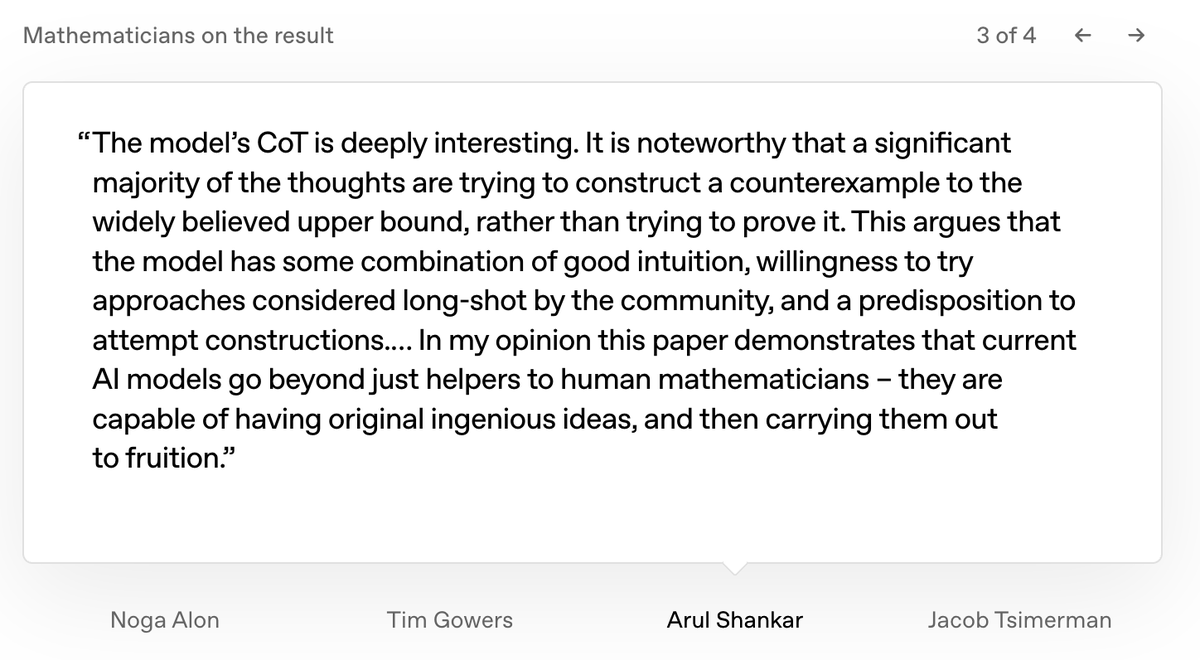 OpenAI@OpenAI
Today, we share a breakthrough on the planar unit distance problem, a famous open question first posed by Paul Erdős in 1946. For nearly 80 years, mathematicians believed the best possible solutions looked roughly like square grids. An OpenAI model has now disproved that belief, discovering an entirely new family of constructions that performs better. This marks the first time AI has autonomously solved a prominent open problem central to a field of mathematics.
someone should probably turn this into a proper benchmark, same w mythos exploit cherrypicking
 bilal@bilaltwovec
 #1499thebes@VOOOOOOGEL
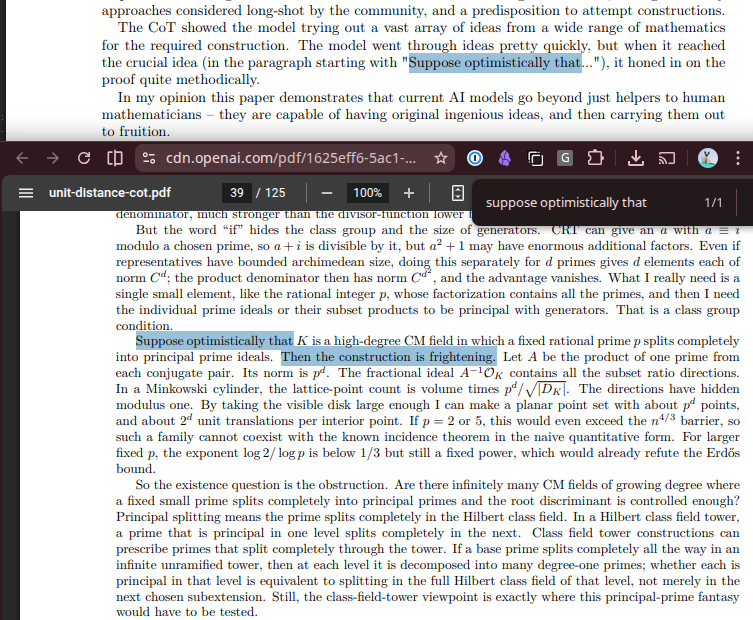
unfortunately openai didn't publish the unsummarized chain of thought, but the summary is 125 pages!
the model reaches the crucial idea (which it describes as 'frightening,' i would love to read the unabridged chain of thought here...) on page 39
 OpenAI@OpenAI
Today, we share a breakthrough on the planar unit distance problem, a famous open question first posed by Paul Erdős in 1946. For nearly 80 years, mathematicians believed the best possible solutions looked roughly like square grids. An OpenAI model has now disproved that belief, discovering an entirely new family of constructions that performs better. This marks the first time AI has autonomously solved a prominent open problem central to a field of mathematics.
 Timothy Nguyen@IAmTimNguyen
A new AI milestone today: "If a human had written the paper and submitted it to the Annals of Mathematics and I had been asked for a quick opinion, I would have recommended acceptance without any hesitation. No previous AI-generated proof has come close to that.” - Tim Gowers 1/
 #1711🍓🍓🍓@IRULETHEWORLDMO
the time is almost here.
OpenAI@OpenAIToday, we share a breakthrough on the planar unit distance problem, a famous open question first posed by Paul Erdős in 1946. For nearly 80 years, mathematicians believed the best possible solutions looked roughly like square grids. An OpenAI model has now disproved that belief, discovering an entirely new family of constructions that performs better. This marks the first time AI has autonomously solved a prominent open problem central to a field of mathematics.
@polynoamial please do.
Noam Brown@polynoamialThis is a general-purpose LLM. It wasn’t targeted at this problem or even at mathematics. Also, it’s not a scaffold. We have not pushed this model to the limit on open problems. Our focus is to get it out quickly so that everyone can use it for themselves.