• Home
  • Technology
  • Gaming
  • Entertainment
  • World & Business
  • Science
  • Sports
  • AI
HomeTechnologyGamingEntertainmentWorld & BusinessScienceSportsAI
AI
Report

The potential cost of AI solving open math problems too soon

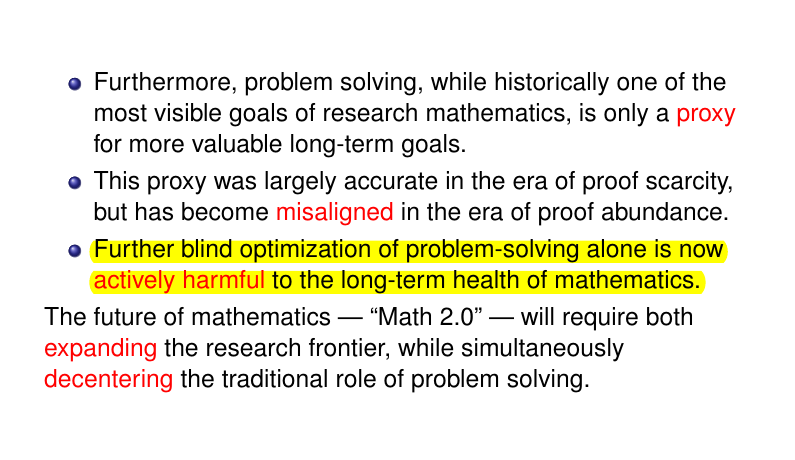
A post quotes a slide attributed to Terence Tao that likens open problems to “lighthouses” guiding exploration.

1 Source, 21m ago, first seen 21m ago

TLDR

A post quotes what it describes as a slide from Terence Tao’s “Math 2.0” lecture at Caltech. In the quoted remarks, open problems guide exploration rather than serve only as targets for solutions, and lessons learned while pursuing them can matter more than the answers. The slide warns that reaching those targets prematurely with automated tools could leave valuable paths unexplored and harm mathematics in the long term.

Combined views

—

1 Source, first seen 21m ago

— likes— comments— saves— reposts

Combined views

—

1 Source, first seen 21m ago

— likes— comments— saves— reposts

Sentiment

Positive——Negative

Summary

Not enough discussion yet.

No sentiment analysis available yet.

Featured Source

Sentiment

Positive——Negative

Summary

Not enough discussion yet.

No sentiment analysis available yet.

1 Source

Rohan Paul@rohanpaul_aiTerence Tao's slide from the lecture he gave yesterday evening at Caltech “Math 2.0” AI can now crack open problems that were once out of reach, and he says that is the wrong thing to celebrate on its own. Basically he says chasing problem-solving alone is hurting math. > “Further blind optimization of problem-solving alone is now actively harmful to the long-term health of mathematics.” > “Contrary to popular opinion (or some of our own marketing), mathematicians are not singularly focused on solving open problems.” > “Particularly in pure mathematics, open problems serve as “lighthouses”: not destinations to be reached in and of themselves, but as useful guides to explore the mathematical landscape around these problems.” > “The lessons learned while attempting to solve these problems — whether they succeed, fail, or achieve partial progress — are often more valuable than the final solution to the problem itself.” > “Reaching these lighthouses prematurely by automated tools can disrupt the exploration of the paths not taken, and sterilize the surrounding field.” “Indiscriminate use of AI to solve problems in a non-renewable fashion damages the long-term health and progress of the field, as well as safe transfer to messier, real-world applications.”1h
    • Home
    • Technology
    • Gaming
    • Entertainment
    • World & Business
    • Science
    • Sports
    • AI

    1 Source

    Rohan Paul@rohanpaul_aiTerence Tao's slide from the lecture he gave yesterday evening at Caltech “Math 2.0” AI can now crack open problems that were once out of reach, and he says that is the wrong thing to celebrate on its own. Basically he says chasing problem-solving alone is hurting math. > “Further blind optimization of problem-solving alone is now actively harmful to the long-term health of mathematics.” > “Contrary to popular opinion (or some of our own marketing), mathematicians are not singularly focused on solving open problems.” > “Particularly in pure mathematics, open problems serve as “lighthouses”: not destinations to be reached in and of themselves, but as useful guides to explore the mathematical landscape around these problems.” > “The lessons learned while attempting to solve these problems — whether they succeed, fail, or achieve partial progress — are often more valuable than the final solution to the problem itself.” > “Reaching these lighthouses prematurely by automated tools can disrupt the exploration of the paths not taken, and sterilize the surrounding field.” “Indiscriminate use of AI to solve problems in a non-renewable fashion damages the long-term health and progress of the field, as well as safe transfer to messier, real-world applications.”1h
    Today's Rank

    #16

    Today's Rank

    #16