Stanford researchers release 60-page arXiv paper 'Reflections and New Directions for Human-Centered Large Language Models' from Diyi Yang's CS329X class with contributions from more than 60 students
Lead authors include Caleb Ziems, Dora Zhao, and Diyi Yang.

Link here: https://arxiv.org/pdf/2605.06901
 Diyi Yang@Diyi_Yang
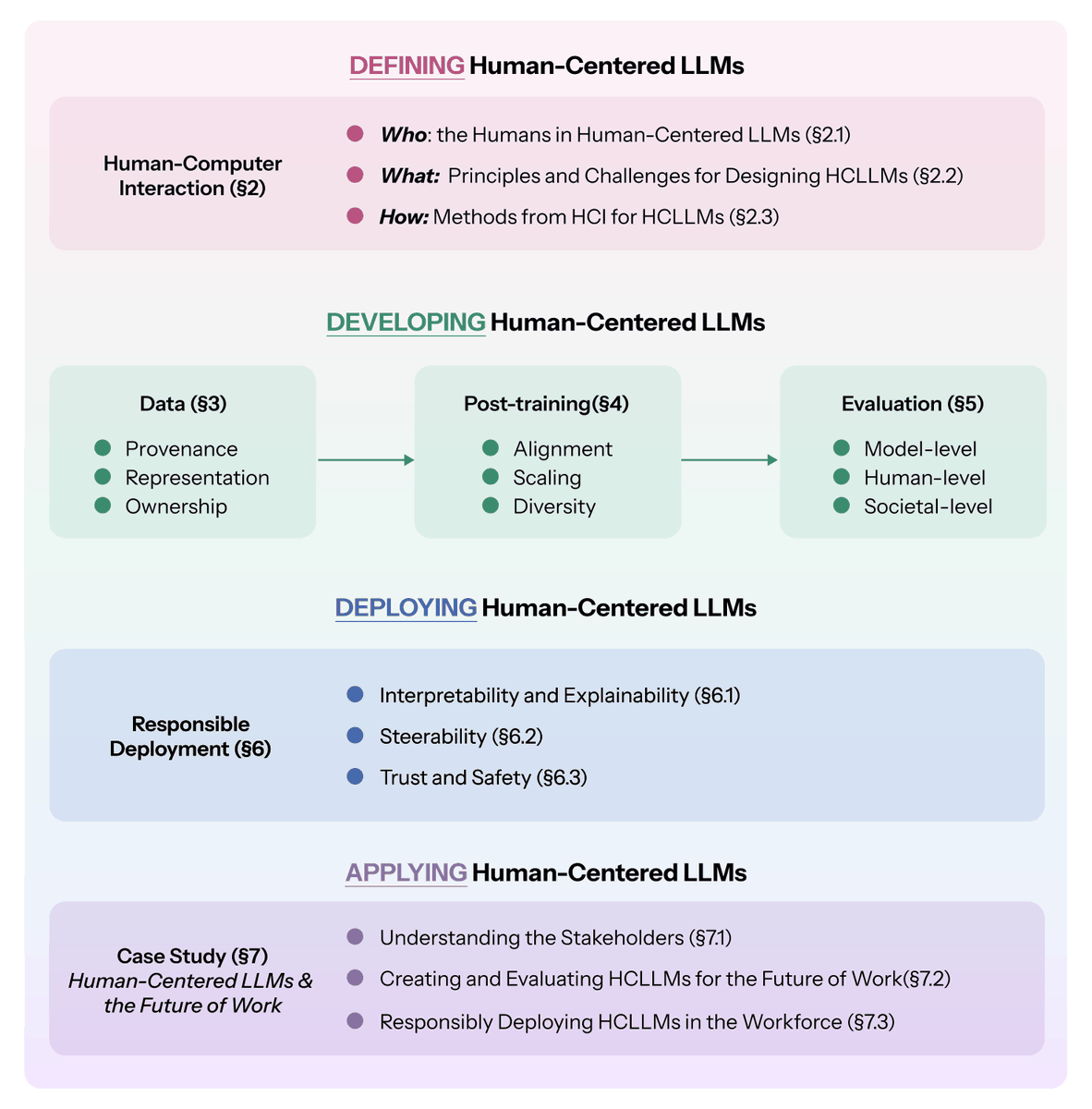
The next frontier of AI is not only more capable model; it is an AI that *humans* can meaningfully live and work with :) With all students in my cs329x Human-Centered LLM class, we present 60+ pages of insights for developing Human-Centered LLMs (HCLLMs), from design & data sourcing to training, eval & deployment 🧵
How do we center humans? We start with HCLLM DESIGN to understand (1) stakeholders, (2) design challenges, and (3) HCI solutions.
E.g., HCI interfaces can close the gap between user intentions and prompts -- a distinct AI design challenge called the "gulf of envisioning"
 Diyi Yang@Diyi_Yang
Link here: https://arxiv.org/pdf/2605.06901
Next, we look at HCLLM DEVELOPMENT from an NLP perspective.
First: training data reflects the people, institutions, cultures, histories, and social contexts that produced it. From data origins, we can understand human-centered concerns around bias, privacy, and data ownership.
 Diyi Yang@Diyi_Yang
How do we center humans? We start with HCLLM DESIGN to understand (1) stakeholders, (2) design challenges, and (3) HCI solutions. E.g., HCI interfaces can close the gap between user intentions and prompts -- a distinct AI design challenge called the "gulf of envisioning"
Second: in post-training, we highlight tensions and tradeoffs around preference tuning, personalization, & pluralism, tying concerns back to our earlier "data" discussion around bias & representation.
We also explore the limitations of scaling laws for human-centered objectives.
 Diyi Yang@Diyi_Yang
Next, we look at HCLLM DEVELOPMENT from an NLP perspective. First: training data reflects the people, institutions, cultures, histories, and social contexts that produced it. From data origins, we can understand human-centered concerns around bias, privacy, and data ownership.
Third, we highlight pitfalls and best practices w/ evals at 3 different scopes: (1) model output, (2) human experience, (3) societal impact.
Currently, the field relies too much on surface heuristics and not enough on orienting HCLLMs towards long-term collective good objectives
 Diyi Yang@Diyi_Yang
Second: in post-training, we highlight tensions and tradeoffs around preference tuning, personalization, & pluralism, tying concerns back to our earlier "data" discussion around bias & representation. We also explore the limitations of scaling laws for human-centered objectives.
After design and development, we look at responsible HCLLM DEPLOYMENT. There is tension between 3 ideals: (1) interpretability, (2) steerability, & (3) safety.
E.g, certain alignment and steering methods can make models less interpretable; more steerable models may be less safe.
 Diyi Yang@Diyi_Yang
Third, we highlight pitfalls and best practices w/ evals at 3 different scopes: (1) model output, (2) human experience, (3) societal impact. Currently, the field relies too much on surface heuristics and not enough on orienting HCLLMs towards long-term collective good objectives
In summary, we show human-centeredness is more than an alignment objective. It is a design approach across the entire HCLLM pipeline, from development to deployment. There are no simple answers.
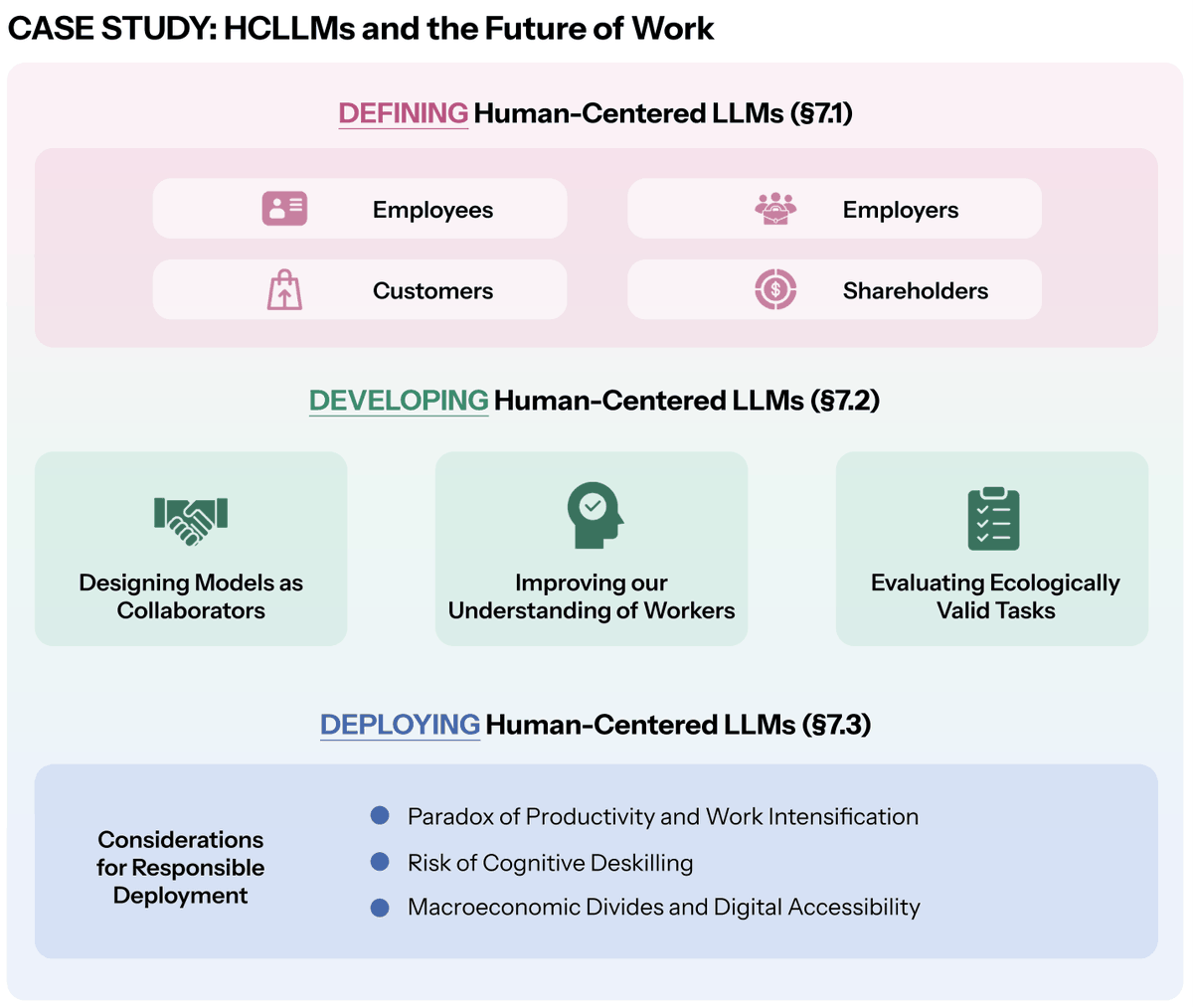
To make this concrete, we conclude w/ a case study on HCLLMs and the Future of Work.
 Diyi Yang@Diyi_Yang
After design and development, we look at responsible HCLLM DEPLOYMENT. There is tension between 3 ideals: (1) interpretability, (2) steerability, & (3) safety. E.g, certain alignment and steering methods can make models less interpretable; more steerable models may be less safe.
This paper was jointly led by @cjziems & @dorazhao9, w/ contributions from over 60 authors across @stanfordnlp and @StanfordHAI, and cs329x! We build on lots of wisdom & empirical contributions of countless researchers across HCI, NLP, and Responsible AI.
Thank you to everyone involved ❤️
Diyi Yang@Diyi_YangIn summary, we show human-centeredness is more than an alignment objective. It is a design approach across the entire HCLLM pipeline, from development to deployment. There are no simple answers. To make this concrete, we conclude w/ a case study on HCLLMs and the Future of Work.
 #442CLS@CHENGLEISI
Tired of AI automating research and solving major open problems? Take a read at Diyi’s new masterpiece to gain more confidence on humans!
Diyi Yang@Diyi_YangThe next frontier of AI is not only more capable model; it is an AI that *humans* can meaningfully live and work with :) With all students in my cs329x Human-Centered LLM class, we present 60+ pages of insights for developing Human-Centered LLMs (HCLLMs), from design & data sourcing to training, eval & deployment 🧵

@ChengleiSi lol
CLS@ChengleiSiTired of AI automating research and solving major open problems? Take a read at Diyi’s new masterpiece to gain more confidence on humans!
 #1971Omar Shaikh@OSHAIKH13
This is like the avengers but for human AI interaction
Diyi Yang@Diyi_YangThe next frontier of AI is not only more capable model; it is an AI that *humans* can meaningfully live and work with :) With all students in my cs329x Human-Centered LLM class, we present 60+ pages of insights for developing Human-Centered LLMs (HCLLMs), from design & data sourcing to training, eval & deployment 🧵