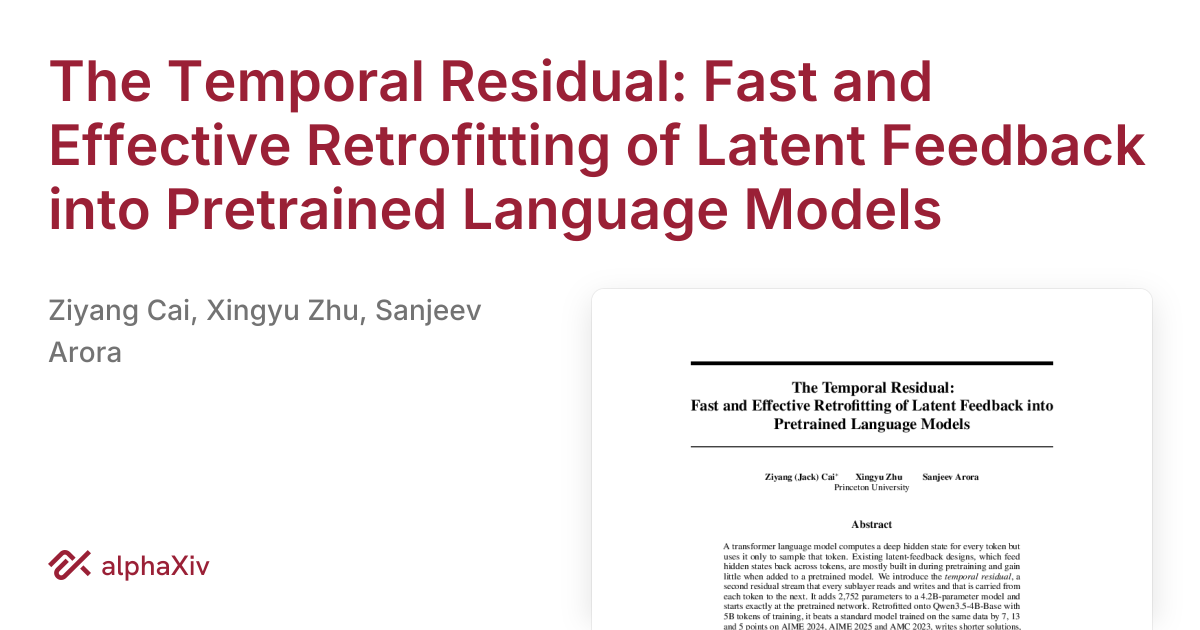
Princeton researchers Ziyang (Jack) Cai, Xingyu Zhu and Sanjeev Arora say their Temporal Residual retrofit lets a pretrained language model carry internal computational state from one token to the next, a technique called latent feedback. The retrofit adds 2,752 parameters to the 4.2-billion-parameter Qwen3.5-4B-Base and improves competition-math results after additional training. Cai announced the work on November 23, 2026. SourceSource
That parameter count is tiny; the workload isn’t. The headline experiments used 5 billion additional training tokens, and fine-tuning cost about 2.9 times as much compute per token as the standard model. Generation was also slower in the researchers’ implementation. Source
What those extra parameters change
Ordinary transformers already attend to earlier tokens. Temporal Residual adds another route for information: a second residual stream, an internal channel that every sublayer reads and writes, whose state is carried forward to the next token. Each sublayer learns how much to use that stream, avoiding the need for designers to pick specific layers between which to feed state back. One less architecture dial to twiddle. SourceSource
The weights that control reading from the added stream start at zero. That means the retrofitted network initially computes exactly what the pretrained model did, then learns to use its new channel. The minimal design adds no new matrices. Source
Both the retrofit and the standard comparison model received 3 billion tokens of continued pretraining followed by 2 billion tokens of supervised fine-tuning. The existing model weights were trained too; this wasn’t a case of freezing the backbone and teaching only 2,752 new parameters. Source
How the math scores compare
Against the standard model given the same additional data and training steps, the researchers report these results: Source
The competition suite contains 100 problems in total, with 16 sampled solutions per problem and a generation budget of 32,000 tokens. The headline figures average two Temporal Residual training seeds and two evaluations of the standard model.




Comments