Researchers behind Mixture-of-Loops Transformer (MoLT) report that their U-shaped architecture matched an OLMo3 validation-loss target with 41.8% fewer training tokens at roughly 700 million parameters. That’s a training-token result, not a receipt for an equally large discount on compute or dollars. Source
The team announced its paper and initial U-MoLT implementation on November 26, following an arXiv submission on November 25, 2026. The project README lists researchers affiliated with Huazhong University of Science & Technology, ByteDance Seed and the University of Toronto. Source Source
What MoLT changes—and what the results measure
According to the project’s results, U-MoLT-700M reached OLMo3’s 400-billion-token result on 11-domain mean validation cross-entropy after 232.8 billion tokens. Cross-entropy measures prediction error; lower is better. The team describes that as approximately 1.7× validation token efficiency, with 1.50% more parameters than the baseline. Source
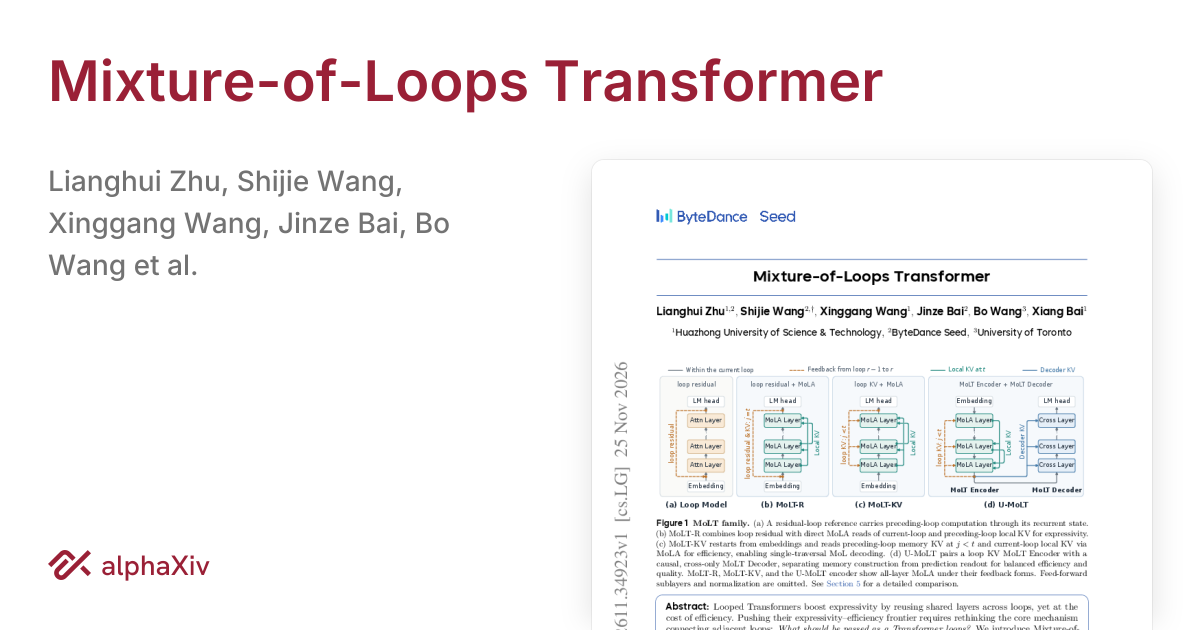
The architectural idea is to change what survives between passes through shared Transformer layers. The authors’ Mixture-of-Loops Attention uses keys and values, or KV, as memory that can be selectively reused across depths and loops. This is memory inside the model’s computation, not an external knowledge store. Source
U-MoLT separates building memory from the decoder’s job of reading it to make predictions. The researchers say it can skip decoder passes in intermediate loops and at all but the final prompt position without changing predictions. Skipping those unused passes does not establish that other decoding schedules produce identical answers. Source
The team also reports aggregate improvements in its 400-billion-token experiments at larger sizes. Its 3B mixture-of-experts model averaged 62.2% accuracy across 10 tasks, versus 60.1% for the OLMo3 baseline, while mean perplexity across 10 domains fell from 13.99 to 13.24. Both models are listed with 660 million active parameters. Source
The speed result belongs to a smaller model
The near-baseline inference result comes from approximately 113-million-parameter models, not the 700M or 3B models above. For a 4,096-token prompt followed by 64 decoding steps, U-MoLT using MoL-Hybrid-2 posted a total latency of 0.9966 seconds, versus 1.0006 seconds for non-looped OLMo3. With a 128-token prompt, the corresponding totals were 0.9944 and 0.9905 seconds. Those few milliseconds hardly warrant a victory lap. Source
Under the plain “Mixture-of-Loops” schedule, U-MoLT took about 47.18 seconds for a 4,096-token prompt plus 64 decoding steps. Source
The README’s benchmark table does not specify hardware, batch size or timing variability. Nor does a 4,096-token latency measurement establish output quality at that length. Source
Initial code, not the whole experimental kit
The repository provides a minimal U-MoLT implementation on BlaGPT, a small-model configuration, and a fused MoLA Triton kernel with tests. But its checklist still marks MoLT-R, MoLT-KV and MoL-Hybrid decoding implementations as pending, along with the full large-scale pretraining recipes and Qwen continued-pretraining code. Source





Comments