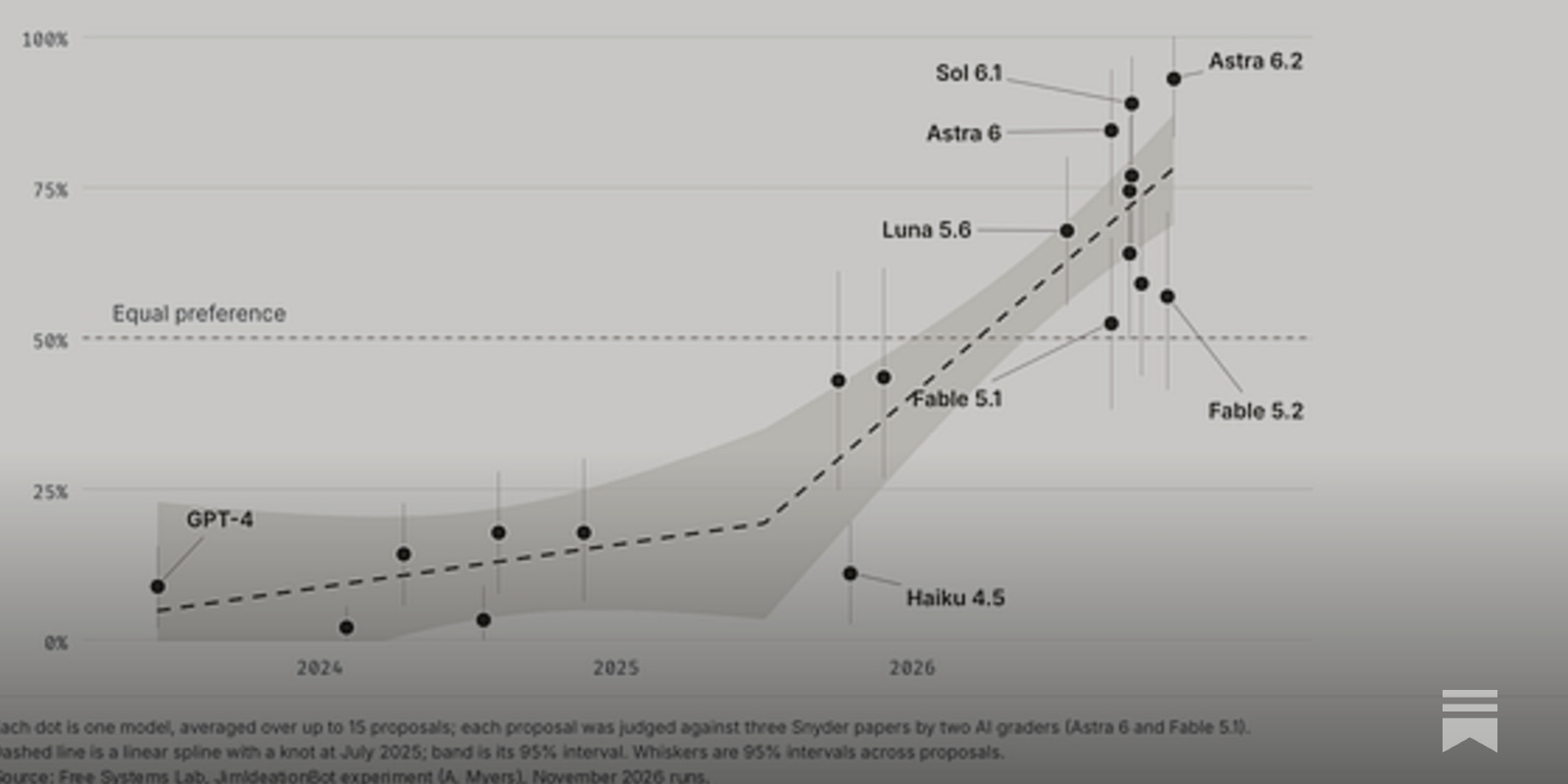
Recent AI models won blind comparisons of American-politics study designs against condensed published papers by political economist Jim Snyder, according to Andy Hall and Andy Myers’ new SnyderBench evaluation. But the models showed much less progress at choosing important research questions. Source
Hall announced the results on November 23. The benchmark compares research proposals, not completed studies—a fairly consequential distinction before anyone starts retiring the political scientists. SourceSource
Stronger designs, not necessarily better questions
Hall and Myers tested 19 OpenAI and Anthropic models, asking each for an empirical causal research proposal 15 times. That produced more than 260 usable proposals. The models also received summaries of 22 Snyder papers as examples. Source
Human graders—PhD candidates in American politics—and AI graders blindly compared model proposals with condensed versions of Snyder’s published papers. The authors say they selected human graders who weren’t very familiar with his work. This wasn’t a contest against fresh proposals Snyder wrote for the occasion. Source
The evaluation separated two judgments:
- Identification: How convincingly would the proposed design answer its research question?
- Contribution: “Assuming its answers were not already known, which proposal would teach us more about an important question or mechanism in American politics?” Source
A beautifully engineered study can still leave a reader asking why anyone needed it.
The authors report a sharp improvement in design ratings among recent models. They put Astra 6.2’s design win rate at 93%, compared with 9% for GPT-4. Those are reported evaluation win rates, not successful-experiment rates, and the write-up doesn’t specify which grader pool underlies the 93% figure. Source
On question quality, only Fable 5.1 clearly exceeded the Snyder benchmark, the authors report. No OpenAI model won more than half of its comparisons on that dimension. Source
The taste test has its own problem
The human graders agreed in 80% of pairwise comparisons on research design, but only 57% on research questions, according to Hall and Myers. The authors contrast that second figure with a 50% random-choice baseline. These are agreement rates, not measures of who was right.





Comments