
DeepSeek V4 sustains performance at two bits per weight
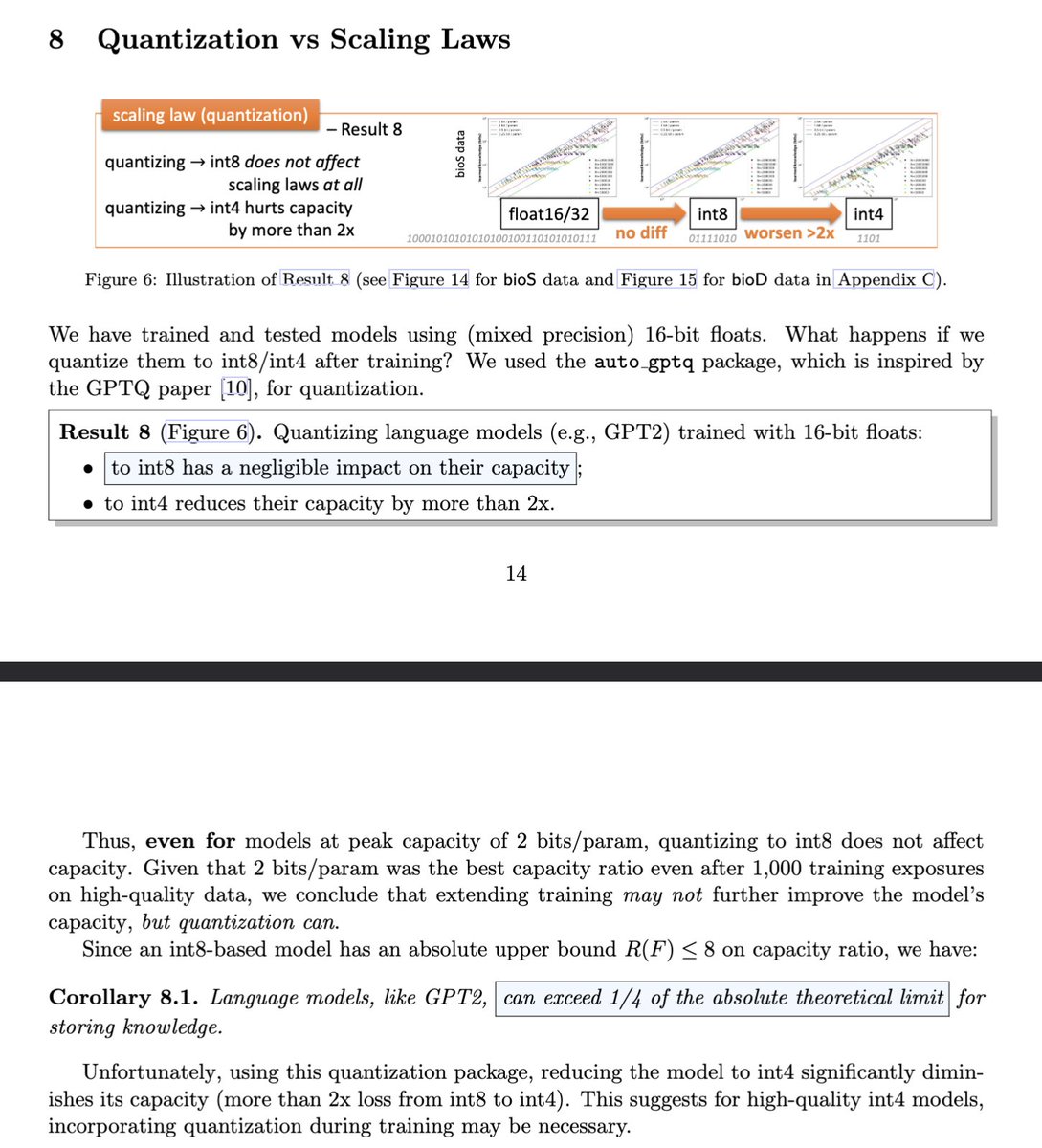
DeepSeek V4 maintains functional performance at roughly two average bits per weight under variable bit rate post-training quantization. Benchmarks on GPQA Diamond, Super GPQA, and AIME2025 showed only modest degradation compared with higher-precision baselines. The result illustrates a decoupling of model knowledge density from weight precision. Earlier models such as Llama 3 experienced sharp capability drops below four bits, while current variable-rate methods avoid comparable losses at the two-bit level.
So one thing that has changed in the last couple years is that model knowledge density has decoupled from weight precision. Remember when we were noticing how Llama 3 is "less quantizable" to, like, Q4? DSV4 functions okay-ishly at *two bits*.
@teortaxesTex well, 2 bits is sort of colloquial here it's more like 2 "avg" bits per weight all serious modern low bit ptq is VBR, if you try to do GPTQ style uniform rounding for the 2 bit range shit obviously explodes to this very day
 Teortaxes▶️ (DeepSeek 推特🐋铁粉 2023 – ∞)@teortaxesTex
So one thing that has changed in the last couple years is that model knowledge density has decoupled from weight precision. Remember when we were noticing how Llama 3 is "less quantizable" to, like, Q4? DSV4 functions okay-ishly at *two bits*.
@teortaxesTex it's possible that there is a regime of activations that conventional PTQ calibration makes systematically worse lets say you have a diverse english calibration set that preserves bits in the ffns most relevant to english gratz, you maybe(?) tanked chinese perf
 kalomaze@kalomaze
@teortaxesTex well, 2 bits is sort of colloquial here it's more like 2 "avg" bits per weight all serious modern low bit ptq is VBR, if you try to do GPTQ style uniform rounding for the 2 bit range shit obviously explodes to this very day
@teortaxesTex on the bloomer side: there is a manifold hypothesis adjacent version of this thought experiment where PTQ calibrated for on-manifold pretraining webtext loses you ~nothing in KLD accuracy outside of high entropy meaning-devoid noise sequences
kalomaze@kalomaze@teortaxesTex it's possible that there is a regime of activations that conventional PTQ calibration makes systematically worse lets say you have a diverse english calibration set that preserves bits in the ffns most relevant to english gratz, you maybe(?) tanked chinese perf
@teortaxesTex i think the bloomer side is closer to the truth and that aggressive weight-side PTQ works better than it has any right to in practice tho
kalomaze@kalomaze@teortaxesTex on the bloomer side: there is a manifold hypothesis adjacent version of this thought experiment where PTQ calibrated for on-manifold pretraining webtext loses you ~nothing in KLD accuracy outside of high entropy meaning-devoid noise sequences